Chipping Sodbury has seen plenty of single-storey extensions and garden room conversions in recent years, and most of them need a flat or low-pitch roof covering. Two of the most common modern choices are EPDM rubber and GRP, also known as fibreglass roofing, and it's a genuinely useful comparison to understand before committing to either.
GRP is applied as a liquid resin that's laid over a fibreglass matting and then cures into a rigid, glass-like surface. It can look very smart when freshly installed and is a capable material in the right hands. EPDM, by contrast, is a pre-manufactured flexible rubber membrane that's rolled out and adhered or mechanically fixed to the deck, often as a single sheet across the whole roof or with very few joints on larger areas.
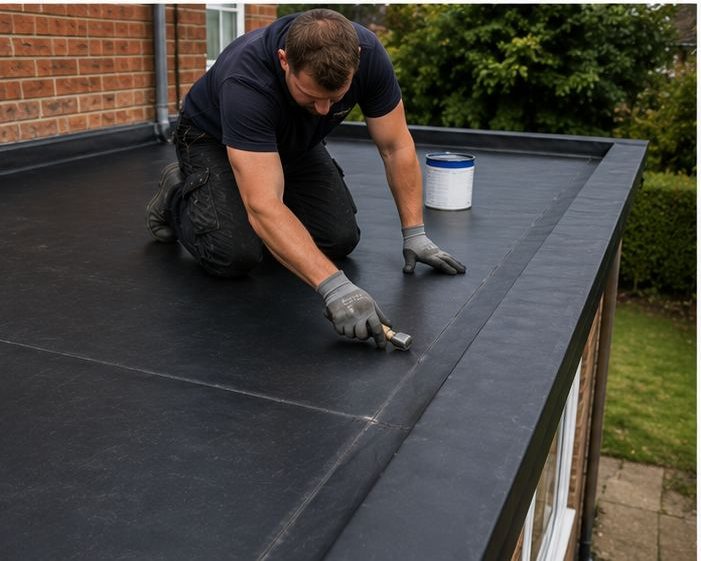
That difference in how each material is applied has real consequences. Because GRP is a rigid finish, any subsequent movement in the roof deck - which can happen with timber over time, particularly with seasonal expansion and contraction - can lead to stress cracking in the resin. EPDM's flexibility means it can accommodate a degree of this movement without the same risk of cracking, which is a meaningful advantage on an extension roof that will be exposed to Chipping Sodbury's seasonal weather for many years.
Seams are another point of difference. A GRP roof relies on the resin curing correctly at joints, upstands and edge trims, and poor detailing or preparation at these points is a common source of problems. EPDM, particularly when installed as large sheets with minimal seams, has fewer of these potential weak spots, which generally makes for a lower-maintenance roof over its life.
In terms of longevity, EPDM is generally considered to be a durable, long-lasting option and is commonly associated with extended manufacturer guarantees when installed correctly, whereas GRP's performance is more dependent on installation quality and can be more prone to issues if the substrate isn't properly prepared or if it flexes over time.
Neither material is inherently wrong for an extension roof, and the right choice can depend on the specific design of your Chipping Sodbury extension, the roof's exposure, and your budget. What matters most is that whichever system is chosen, it's installed correctly by someone who understands the detailing involved.
Cost is often a factor in this decision too, and the two materials can come out fairly similar in price depending on the specifics of the roof, so it's rarely sensible to choose purely on cost alone. Maintenance is worth weighing up as well - EPDM generally needs very little beyond keeping outlets clear, while a GRP roof can occasionally need attention to its top coat over the years to keep it performing at its best.
Ultimately, both materials have a genuine track record when installed well, and the more important factor is choosing an experienced installer who works to a high standard, whichever system you settle on for your extension.
If you're planning an extension and trying to decide between EPDM and GRP, it's worth talking it through with a contractor who fits both and can give you an honest, unbiased recommendation based on your specific roof rather than a one-size-fits-all answer. Brunel Roofing Bristol would be happy to discuss your Chipping Sodbury project and help you choose the right system.
Get a Free Quote for EPDM Roofing in Chipping Sodbury
Every roof is different — the fastest way to get an accurate answer is a quick chat with our team.