
Montpelier's terraced streets and period conversions mean parapet walls, party walls and abutments are a common feature of the area's flat roofs, and how EPDM is detailed around them makes a real difference to how well the finished roof performs over the years.
A parapet wall creates a vertical surface that the roof membrane has to turn up and terminate against, rather than simply running flat and finishing at a gutter edge. On an EPDM installation, this generally means dressing the membrane up the face of the parapet to a suitable height, forming a neat, continuous upstand rather than a separate piece that could become a weak joint.
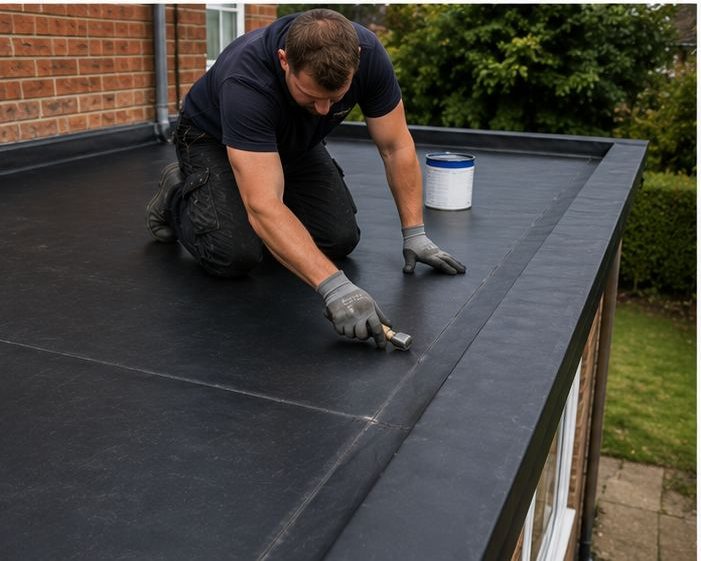
The termination point at the top of that upstand is one of the most important details on the whole roof. It typically needs a mechanically fixed trim or a formed termination bar, sometimes with additional weatherproofing such as a capping or counter-flashing, to stop water getting behind the membrane at the highest point of the wall. A poorly finished termination here is one of the most common causes of leaks on older parapeted roofs in areas like Montpelier.
Where a flat roof abuts a neighbouring property's wall, similar principles apply, but there's often less room to work with and the existing brickwork or render may not be in perfect condition. In these situations, the membrane still needs to be taken up the wall to a safe height and properly terminated, sometimes requiring a chase to be cut into the masonry so the top edge can be tucked in and sealed rather than simply fixed to the surface, which gives a more durable, weathertight result.
Corners where a parapet or wall meets another wall or a change in roof level need particular care, since these internal and external corners are where standard trims often don't fit neatly. A well-executed EPDM installation uses formed corner pieces or hand-dressed detailing at these points to maintain a continuous, seamless waterproof layer rather than relying on multiple overlapping patches.
Getting this detailing right takes experience with the specific layout of older properties, because no two Montpelier parapets are quite identical — wall heights, coping details and roof levels all vary from one terrace to the next, and the installation needs to be adapted accordingly rather than treated as a standard, one-size-fits-all job.
Coping stones on top of a parapet also need attention during an installation. If they're loose, cracked, or the pointing between them has deteriorated, water can get in from above and travel down inside the wall regardless of how well the roof membrane below has been detailed, so it's worth having these checked as part of any wider roof assessment on a Montpelier property.
If you have a Montpelier property with parapet walls or awkward abutments on a flat roof, Brunel Roofing Bristol can assess the existing detailing and explain exactly how an EPDM installation would be approached to keep those junctions properly sealed for the long term.
Get a Free Quote for EPDM Roofing in Montpelier
Every roof is different — the fastest way to get an accurate answer is a quick chat with our team.