
Many properties around The Downs have a flat-roofed extension or garage sitting alongside or beneath a traditional pitched, tiled or slated roof, which means the junction between the two roof types is a genuinely important detail to get right. This is one of the more common points of weakness on a mixed-roof property if it isn't handled properly.
The basic principle at this junction is that the flat EPDM membrane needs to run up behind the pitched roof covering, rather than simply butting up against it, so that water running down the pitched roof is directed onto the flat roof surface and away, rather than finding a gap to seep through at the join.
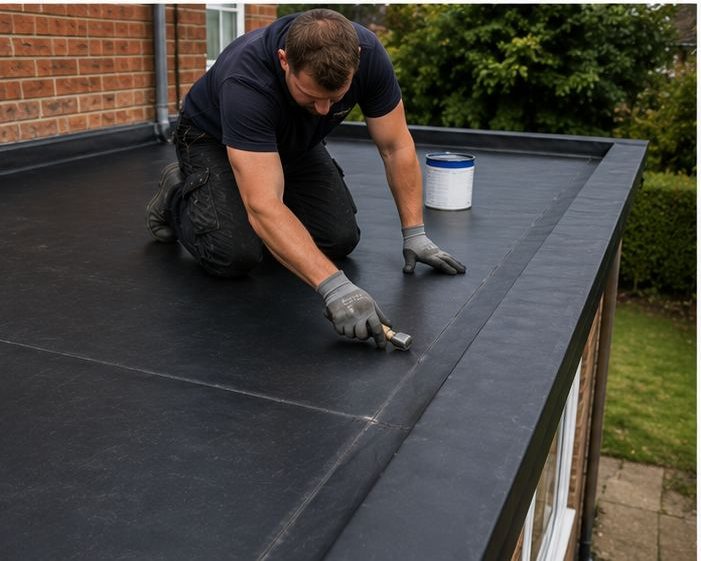
The exact detailing needed can vary quite a bit depending on the specific arrangement — whether the flat roof sits below a tiled roof slope, meets a gable wall, or wraps around a dormer, for example — and properties around The Downs show a fair amount of variety in exactly how these junctions were originally built, which is why each one really needs assessing on its own merits.
In practice, this usually means dressing the EPDM membrane up as an upstand against the wall or fascia where the two roofs meet, and ensuring it's tucked under the lowest course of tiles or slates on the pitched section above, so there's a continuous, overlapping line of defence against water rather than a simple abutting seam.
Flashing details often come into play at this junction too, particularly where the flat roof meets a wall that continues up past the roofline. Lead or an equivalent flashing material is typically used in combination with the EPDM upstand to create a robust, weathertight seal that can also accommodate a small amount of movement between the two roof structures over time.
Getting this detail wrong is one of the more common causes of leaks on properties around The Downs with this kind of mixed roof arrangement. A poorly formed junction might look acceptable at first glance but can allow water to track behind the flashing or under the tiles during heavy or driving rain, leading to damp problems that can be hard to trace back to their source.
Because this junction sits at the meeting point of two quite different roofing systems, it benefits from a roofer who's genuinely experienced with both EPDM and traditional pitched roofing, rather than someone who only works with one or the other. Understanding how each system behaves is what allows the junction to be detailed properly.
This junction is also worth checking periodically even when there's no obvious sign of a problem, since flashing and upstand details can gradually work loose over years of thermal movement and weathering. A quick visual check every so often, or as part of a general roof maintenance visit, can catch a developing weakness at this junction long before it turns into an active leak inside the property.
If your property near The Downs has a flat roof meeting an existing pitched roof, it's worth having that junction assessed carefully, whether you're planning new work or investigating an existing leak. Brunel Roofing Bristol has the experience to detail this kind of junction properly and can provide a clear quotation for the work involved.
Get a Free Quote for EPDM Roofing in The Downs
Every roof is different — the fastest way to get an accurate answer is a quick chat with our team.