
Extensions and porches are two of the most common places to find a flat or low-pitched roof across Patchway, and while they're very different in scale, EPDM rubber membrane suits both applications well, provided the installation is approached with each roof's particular demands in mind.
On an extension roof, which tends to be larger and often sits above a habitable space, EPDM's flexibility is a real advantage. It's supplied in large, seamless sheets that can be dressed around corners, upstands and abutments with relatively few joints, which matters given that an extension roof often has to meet the original house wall, windows, or changes in roof level at several points.
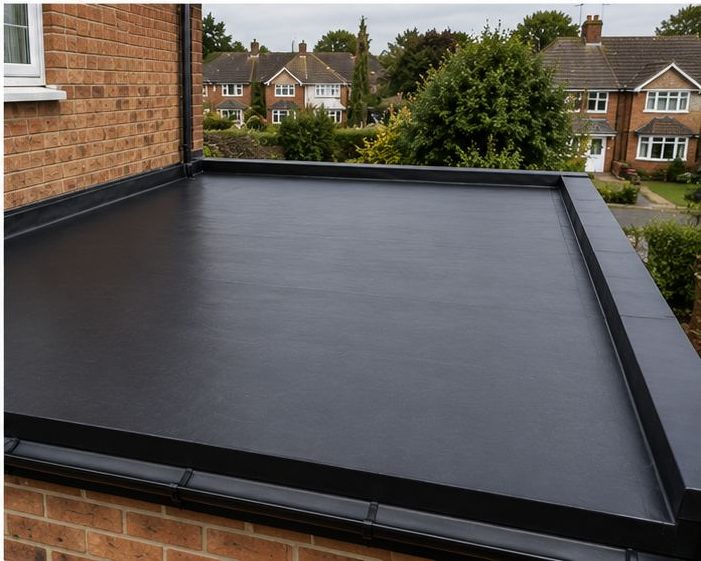
Porch roofs are usually much smaller, but they come with their own specific challenges — tight spaces, close proximity to a front door and often more complex junctions relative to their size, such as meeting a house wall on two or three sides. EPDM's flexibility works well here too, allowing the membrane to be shaped neatly around a compact, awkward roof without needing multiple pieces stitched together.
For both extensions and porches, weather resistance matters just as much as it does on a larger roof. Patchway sees the same mix of driving rain, damp spells and summer heat as the rest of the region, and EPDM copes well with all of it without becoming brittle or losing its seal, which is particularly important on a porch roof that's directly exposed at the front of a property and highly visible if anything goes wrong.
A good result on either type of roof still depends on more than just the membrane. The deck underneath needs to be sound and properly fixed, the roof needs adequate fall to direct water to an outlet or gutter rather than letting it pool, and any junctions against the main house wall need to be correctly flashed to stop water tracking behind the membrane — this is especially important on porches, where the roof often meets brickwork on multiple sides.
Insulation is worth considering on an extension roof used as living space, though it's typically less of a priority on a porch, which is usually unheated. Either way, the right approach depends on how the specific space is being used.
It's also worth thinking about how a porch or extension roof ties into the wider look of the property. EPDM's smooth, low-profile finish tends to sit neatly against brickwork and rendered walls without drawing attention to itself, which suits the front-facing prominence of a porch roof as well as the more discreet position a rear extension roof usually occupies.
Whether you're planning a new extension, replacing an old porch roof, or upgrading either from a failing felt covering, EPDM is a solid option for both applications. Brunel Roofing Bristol can assess your Patchway property and advise on the right approach for your specific roof.
Get a Free Quote for EPDM Roofing in Patchway
Every roof is different — the fastest way to get an accurate answer is a quick chat with our team.