
Old Market's mix of older commercial buildings, Georgian and Victorian terraces and rear extensions means many properties here don't have just one roof to think about. A house might have its main pitched roof at the front, plus a lower rear extension, a converted workshop, a former commercial outbuilding, or a flat-roofed addition tucked behind it, each with its own covering, age and condition, sometimes added at entirely different points in the building's history.
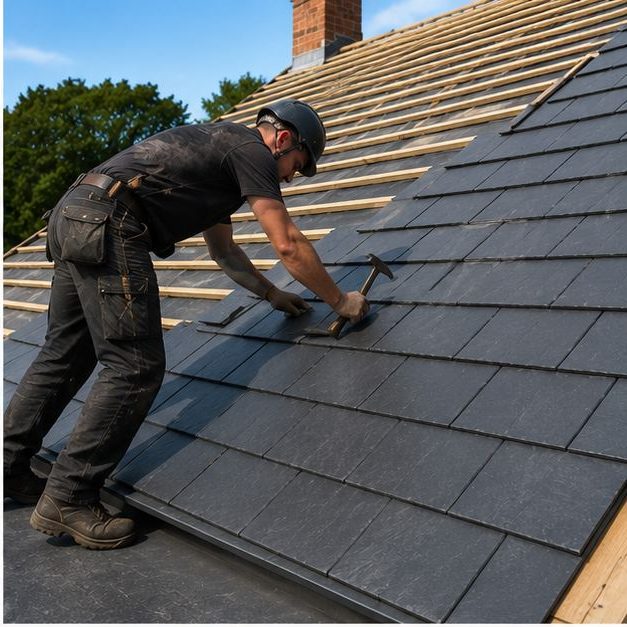
When it's time to replace the main roof, it's worth stepping back and looking at these secondary structures as part of the same project rather than as something separate to be dealt with later. A brand new pitched roof at the front paired with a tired, patched flat roof or an ageing outbuilding covering at the rear can look disjointed from certain angles, and can also leave a weak point in the property's overall weatherproofing that undermines the investment made in the main roof, since water finds the weakest junction rather than respecting which part was recently replaced.
Materials and detailing need to work together at the junctions too. Where a rear extension or outbuilding roof meets the main house, the flashing, guttering and fall of water all have to be coordinated so that the new work doesn't simply push a problem from one part of the roof to another, or overload a downpipe that was never designed to cope with water from an enlarged catchment area. This is particularly relevant on Old Market properties where older rear additions were often built at different times, by different hands, without much thought for how they'd eventually need to be maintained together.
Choosing coverings that complement each other, even where they're different materials, such as a traditional tile on the main roof and a modern flat roofing system on a lower extension, helps the whole property read as a coherent piece of work rather than a series of separate patches added over the years by different owners with different priorities.
It's also a practical moment to address the condition of any outbuilding structure itself, since a re-roof project already involves scaffolding, access and a roofing crew on site, making it a sensible time to deal with a tired flat roof rather than leaving it for a separate visit later. Combining the work in this way often works out more cost-effective than commissioning two separate projects months apart, each with its own setup and access costs.
Where a former commercial outbuilding has been converted for residential use, its roof may also need to meet a different standard than when it was purely a workshop or store, particularly around insulation and ventilation, and this is worth reviewing at the same time as the main house roof rather than assuming the existing covering is still fit for purpose.
If your Old Market property has a main roof and one or more outbuildings or extensions that need attention, Brunel Roofing Bristol can look at the whole picture together and put forward a plan that ties the work together properly, rather than treating each roof in isolation.
Get a Free Quote for New Roof Installations in Old Market
Every roof is different — the fastest way to get an accurate answer is a quick chat with our team.