
Looking up at a roof in Brislington covered in patches of green, grey and black growth, it is easy to lump it all together as simply moss. In fact, moss, algae and lichen are three distinct organisms, and understanding the difference helps explain why a proper roof clean addresses more than just one type of growth. Knowing the difference also helps set realistic expectations for how a clean is likely to look immediately afterwards.
Moss is the most visually obvious of the three. It grows in soft, cushion-like clumps, typically green in colour, and tends to establish itself in damp, shaded spots such as roof valleys, around chimneys, and along ridge lines where moisture collects and lingers longest. It holds water against the tile surface, which over time can be genuinely harmful to the roof underneath it.
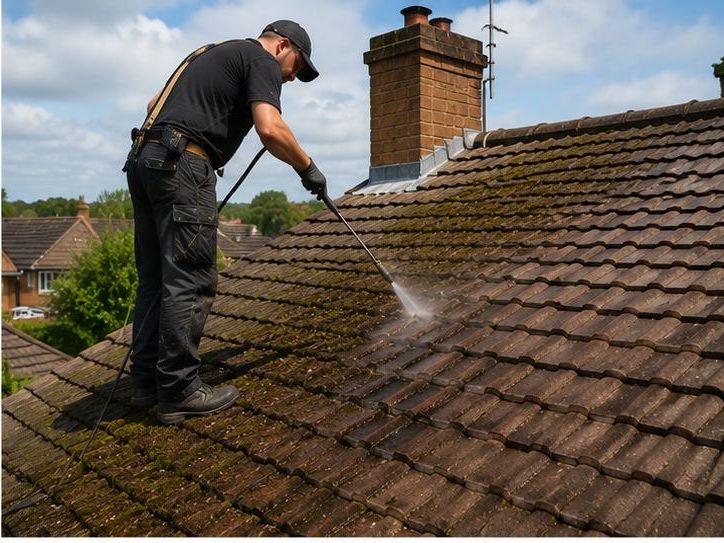
Algae, by contrast, shows up as a flatter, thinner film across the tile surface, often appearing as green or black streaking rather than distinct clumps. It needs less soil and debris to get started than moss does, and it thrives on shaded or north-facing slopes where the roof stays damp for longer after rain, which is common on many properties in Brislington depending on their orientation and surrounding buildings.
Lichen is the trickiest of the three to deal with, and the one most likely to be mistaken for a harmless patch of discolouration. It appears as crusty, often grey, orange or pale green patches that bond tightly to the tile surface, sometimes almost fusing with it over many years. Because lichen anchors itself so firmly, it generally needs a slower, more patient approach to remove without damaging the tile underneath.
All three tend to appear together on roofs that have gone a long time without attention, particularly in shaded or tree-lined parts of Brislington, and a proper clean needs to address the specific mix present on a given roof rather than applying a single generic treatment and hoping it works on everything.
This is why our soft-wash approach uses biocide treatment tailored to deal with moss, algae and lichen together, working at a level that treats the growth itself rather than simply trying to force it off the surface, which is particularly important where lichen has bonded strongly to older tiles.
Knowing which of the three you are dealing with also affects how urgently action is worth taking. Moss holding significant moisture against tiles is generally the priority to address, since it has the most direct effect on the roof surface over time. Algae staining, while visually noticeable, tends to be less immediately harmful, and lichen, though stubborn, grows slowly enough that a well-planned, careful removal approach is usually more appropriate than treating it as an emergency. A proper assessment helps prioritise a Brislington roof's specific mix correctly.
It is also useful to know that all three can vary considerably in colour depending on the specific species present and the tile material underneath, so a Brislington roof might show anything from bright green moss cushions to pale grey lichen patches, sometimes within the same small area.
If your roof in Brislington has a mix of green, grey and black patches and you are unsure exactly what you are dealing with, we are happy to take a look and identify what is actually growing there and the best way to deal with it properly.
Get a Free Quote for Roof Cleaning in Brislington
Every roof is different — the fastest way to get an accurate answer is a quick chat with our team.