
Leadwork rarely gets much thought from homeowners until it fails, but it does a disproportionate amount of work protecting the trickiest parts of a roof: chimneys, valleys, abutments where a roof meets a wall, and other junctions where a simple run of tiles cannot keep water out on its own. When a re-roof is being planned in Brentry, deciding what to do with the existing leadwork is a question worth asking directly, rather than assuming it will simply be left in place untouched or automatically renewed regardless of its condition.
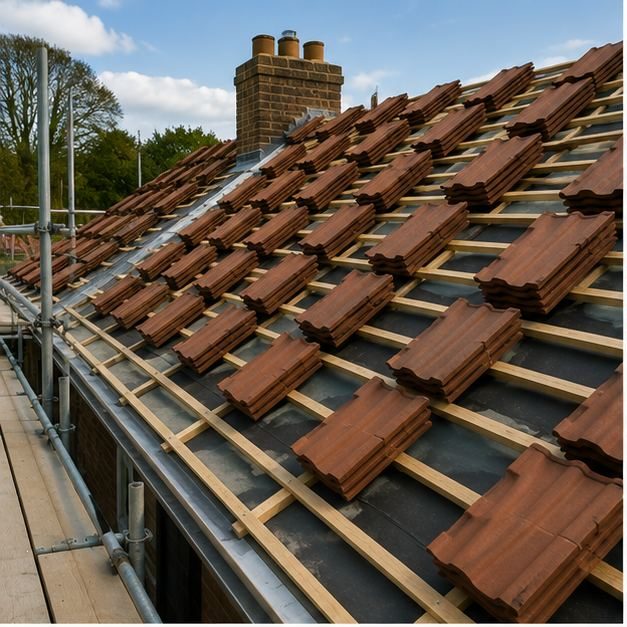
Lead is a genuinely long-lasting material when it has been properly installed in the first place, and it is not unusual for sound leadwork to outlast more than one generation of tiles above it. Because of this, leadwork in good condition does not always need to be replaced purely because the rest of the roof is being renewed at the same time. The real question is whether the lead itself, and the way it has been dressed, formed and fixed, is still doing its job properly rather than simply looking present.
The signs that old leadwork needs attention are fairly consistent across most properties: cracking or splitting, particularly at bends and folds where the lead has been worked into shape over a chimney or valley, patches that have lifted or pulled away from the abutment they were meant to seal, and a chalky, uneven surface texture that suggests the metal has become brittle with age and repeated expansion and contraction. Poorly installed leadwork from years past, sometimes with fixings or a fall that were never quite right to begin with, is also a common source of ongoing, hard-to-trace leaks around chimneys on older Brentry properties.
Because leadwork sits at the junctions most prone to leaks in the first place, it makes sense to assess it properly at the same time as a re-roof rather than treating it as an afterthought once the main tiling work is underway. Renewing tiles above ageing or poorly fitted lead can mean paying for an entire new roof while the same recurring leak around a chimney or valley remains completely unresolved, which rather defeats much of the purpose of doing the work in the first place.
Where leadwork does need renewing, it is also worth understanding what standard is being used. Code 4 or Code 5 lead to British Standard is the industry expectation for most domestic applications, and cutting corners here with a thinner, cheaper alternative can shorten the working life of an otherwise well-executed re-roof considerably. A modest saving on the leadwork can end up costing far more in future repairs once it fails years ahead of the rest of the roof.
As part of any re-roofing quote, Brunel Roofing Bristol will assess the condition of the existing leadwork and advise honestly on what genuinely needs replacing and what can reasonably be retained, rather than automatically renewing everything regardless of its actual condition.
Get a Free Quote for New Roof Installations in Brentry
Every roof is different — the fastest way to get an accurate answer is a quick chat with our team.