
Chimneys are a defining feature of many period properties across Redland, standing tall on rooflines that have often seen little maintenance attention at that height for years at a time. It is also one of the areas most prone to heavy moss build-up, and unfortunately one where that build-up can hide genuine problems if left unchecked.
The junction where a chimney meets the roof is inherently more complex than an open expanse of tile or slate. Flashing, typically lead in older Redland properties, is used to create a watertight seal at this point, and mortar fillets or haunching around the base of the chimney help keep water from tracking in where the brickwork meets the roof covering. These junctions tend to be more sheltered and slower to dry than the rest of the roof, which makes them a particularly favourable spot for moss to establish and thrive.
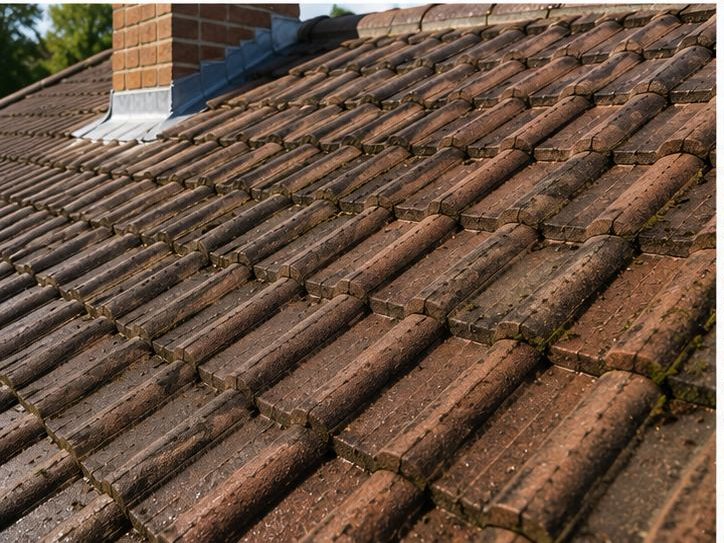
As moss builds up around a chimney over time, it can grow directly over flashing and mortar in a way that makes it very difficult to judge their condition from a distance or even from a reasonably close look. A section of flashing that has begun to lift, or mortar that has started to crack and crumble with age, can be almost entirely obscured beneath a thick covering of green or black growth.
This matters more here than on many other parts of the roof, because chimney junctions are a well-known point for leaks to develop on period properties. Water finding a way past compromised flashing or failed mortar at the base of a chimney can travel down into the loft space or even further into the property, often before any sign becomes visible from inside the home.
Given how common chimneys still are on Redland's Victorian and Edwardian housing stock, and how many of these chimneys have stood for well over a century, it is worth having this area checked properly rather than assumed to be sound simply because there are no obvious signs of a leak yet.
Chimney stacks themselves are also worth a mention, since the brickwork and pointing on an old stack can deteriorate in similar ways to the mortar at its base, and moss or lichen growing on the stack itself can mask the same kind of gradual weathering. Checking the stack alongside the roof junction gives a more complete picture of this whole area's condition rather than looking at the base in isolation.
Even chimneys that are no longer in active use, which are fairly common across Redland where many period fireplaces have been decommissioned over the years, still need their flashing and mortar to remain sound. A capped or unused stack does not need a functioning flue, but it still relies on the same watertight junction with the roof, so it is just as worth checking as one still connected to a working fireplace below.
A careful clean removes the moss covering these junctions and gives a genuine opportunity to assess the flashing and mortar underneath, often for the first time in a good number of years.
If you have a chimney on your Redland roof and are concerned about what might be hiding beneath the moss around it, Brunel Roofing Bristol can clean the area thoroughly and check its condition as part of the visit.
Get a Free Quote for Roof Cleaning in Redland
Every roof is different — the fastest way to get an accurate answer is a quick chat with our team.