
Chimneys and roof valleys are two of the most vulnerable points on any pitched roof, and they are also, unfortunately, two of the places where moss tends to establish itself most readily. On the many period properties found throughout Henleaze, with their often more complex rooflines and multiple chimney stacks, this combination is worth paying particular attention to.
Valleys, where two roof slopes meet, naturally collect more moisture and debris than flatter sections of tile, simply because that is where water, leaves and general organic matter are channelled as they run off the roof. This makes valleys an ideal environment for moss to take hold, and once established there, growth can build up thickly over time, partly protected from wind and direct sun by the surrounding roof slopes.
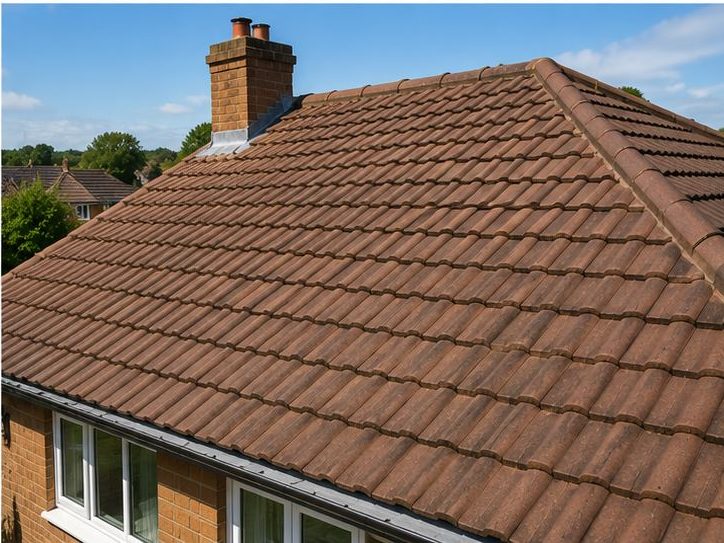
The problem with moss accumulating in a valley is that this is also one of the most critical areas for keeping water flowing correctly off a roof. A valley clogged with thick moss and trapped debris can restrict water flow, forcing it to find another route, sometimes under tiles or lead flashing rather than down and away as intended, which is exactly the kind of hidden issue that can develop into a leak over time.
Chimneys present a related but slightly different concern. The flashing around a chimney stack, typically lead or a similar material, is designed to create a watertight seal between the chimney and the surrounding roof tiles, but this junction is also a common place for moss to establish itself, particularly on the shaded side. Moss growing against flashing holds moisture directly against it, which can accelerate wear on a component that is already one of the more failure-prone parts of any roof.
Because both of these areas are relatively difficult to inspect properly from the ground, moss can build up around chimneys and in valleys for a considerable time without being noticed, quietly increasing the risk of water finding its way in at exactly the points where a roof is most likely to develop a leak.
Removing moss from these areas as part of a proper roof clean brings them back into full view, allowing flashing and valley condition to be properly checked rather than left as an unknown, hidden beneath growth that has been building up unseen.
Given how much water is channelled through valleys and around chimney bases during heavy rain, even a partial restriction caused by moss and trapped debris can have a noticeable effect during the wettest parts of the year, precisely when a roof's drainage is being tested most. Checking these areas is therefore not just about tidiness but about confirming that water is genuinely able to move away from the roof as intended, particularly on the more complex rooflines found on many Henleaze period properties.
For a Henleaze property with multiple chimney stacks or an unusually complex roofline, it is worth having each junction checked individually rather than assuming a general assessment of the main roof slopes has adequately covered these more detailed, higher-risk areas as well.
If your Henleaze property has moss building up around chimneys or in roof valleys, Brunel Roofing Bristol can assess these areas properly and advise on the most suitable way to clean and check them.
Get a Free Quote for Roof Cleaning in Henleaze
Every roof is different — the fastest way to get an accurate answer is a quick chat with our team.