
Leadwork and flashings appear all over the flat roof sections of Redland's period properties, typically around chimneys, at junctions with slate or tile roofs, and along abutments where a flat roof meets a wall. These details are meant to provide a weatherproof seal at exactly the points where a single membrane cannot do the job alone, but they are also one of the more common sources of leaks on older flat roofs when something has gone wrong.
One of the most frequent causes of leaks around leadwork is simple age and deterioration. Lead is a durable material, but over many decades it can develop cracks, particularly at bends and joints, or the mortar and pointing that holds it in place against a wall or chimney can gradually fail, creating a gap that lets water track behind the flashing rather than over it.
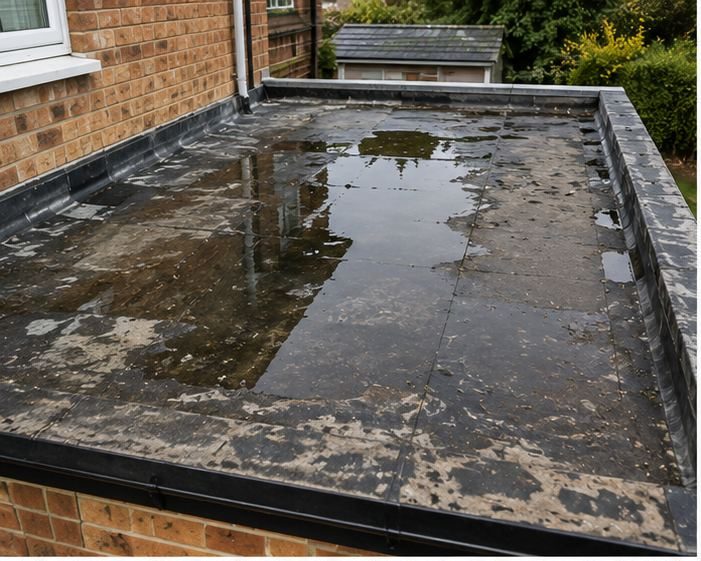
Movement is another common contributor, especially on older Redland buildings that have settled gradually over more than a century. As a chimney or wall moves even slightly relative to the roof structure, flashing that was originally fitted snugly can be pulled away from its seal, creating a small gap that may not be obvious from a casual look but is more than enough to let water in during heavy rain.
Poor original installation is also a factor worth mentioning honestly, particularly on properties that have had various repairs carried out over the years by different tradespeople. Flashing that was not dressed properly into a wall, or was fixed with an inadequate amount of overlap with the roof covering, is more likely to fail than a detail that was installed correctly from the start, and it is not always obvious from the surface which category a given piece of flashing falls into.
Where a flat roof covering, whether felt, EPDM, or another material, meets leadwork, the quality of that specific junction matters enormously. If the roof membrane is not properly bonded or dressed up against the flashing, water can find its way into the gap between the two materials even if both the membrane and the flashing are individually in good condition elsewhere.
Thermal movement plays a role too. Lead expands and contracts with temperature changes more than some other materials, and over time this can work fixings loose or create small stress points, particularly at longer, unbroken runs of flashing that have not been detailed with enough allowance for that movement.
Because leadwork and flashing problems often show themselves as leaks some distance from the actual fault, water can travel along a roof deck or down the inside of a wall before it appears as a stain, diagnosing the true source of a leak in this area properly usually requires a hands-on inspection rather than a guess based on where the damp patch has appeared inside the property.
If you have noticed leaks near a chimney, wall junction, or other flashed detail on a flat roof in Redland, Brunel Roofing Bristol can inspect the leadwork and surrounding roof covering, identify the actual source, and put it right properly.
Get a Free Quote for EPDM Roofing in Redland
Every roof is different — the fastest way to get an accurate answer is a quick chat with our team.