Planning a new extension in Frenchay inevitably raises the question of what to cover the flat roof with, and it is a decision worth taking seriously since the covering chosen will affect how well the roof performs for years, if not decades, to come. The three main options homeowners typically encounter are traditional felt, GRP fibreglass, and EPDM rubber membrane, each with its own characteristics worth weighing up against your specific project.
Felt roofing remains the lowest-cost option upfront and can be a reasonable choice for smaller, less visible roof sections, but it is generally the least durable of the three, relying on overlapping layers with joints that represent the most likely point of eventual failure. Felt roofs often need replacement or significant repair within roughly 10 to 15 years, which is a meaningful consideration for a new extension you presumably want to enjoy without major roofing work for as long as possible.
GRP offers a hard, rigid, seamless surface that some Frenchay homeowners favour for its walkable finish, useful where roof access is needed for maintenance or window cleaning. However, its rigidity is also a limitation, since GRP has little ability to accommodate movement in the deck beneath it, and any settlement or thermal flex in a newly built extension roof can risk cracking the resin over time. Repairs to GRP are also more involved than for a flexible membrane, typically requiring the damaged resin to be ground back and re-laminated.
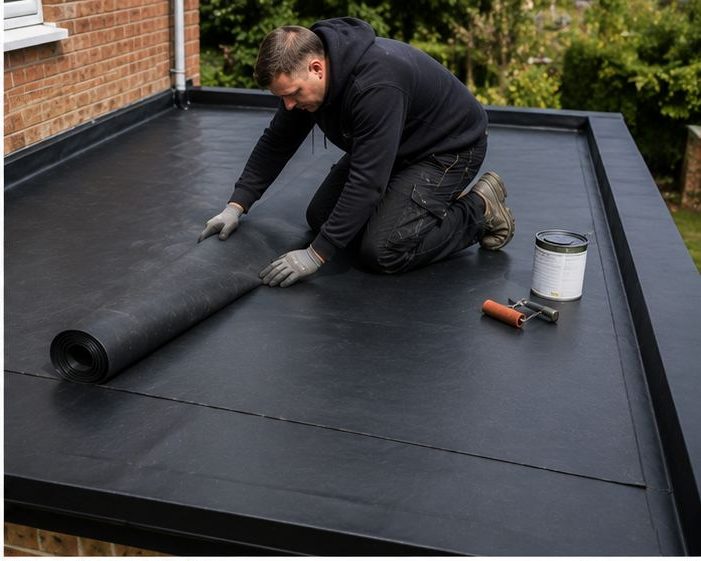
EPDM tends to be the preferred choice for most new extension roofs in Frenchay, largely because it combines genuine flexibility with minimal seams and strong long-term durability. Its ability to move with the roof structure without cracking is particularly useful on a brand-new extension, where some initial settlement is a normal part of any new build bedding in over its first year or two. EPDM is also commonly guaranteed for 20 years or more, offering strong long-term value relative to felt's shorter typical lifespan.
The specific shape and detailing of your extension roof also matters when choosing a covering. A simple rectangular roof with minimal penetrations suits any of the three systems reasonably well, but a roof with a lantern rooflight, multiple pipe penetrations from bathroom or kitchen extraction, or complex junctions against the main house benefits particularly from EPDM's ability to be dressed neatly around awkward details without the need for multiple resin sections or numerous felt joints.
Insulation specification should be considered alongside the covering choice, since building regulations set minimum thermal performance requirements for new extensions, and the roof build-up needs to be designed to meet these while working correctly with whichever membrane is chosen.
It is also sensible to think ahead to how the roof will be maintained once the extension is finished. A membrane with minimal seams and good puncture resistance, such as EPDM, tends to be more forgiving of the occasional bit of roof access needed over the years, whether that is clearing debris, checking a rooflight, or investigating a gutter, without the same level of concern about accidentally causing damage that a more delicate covering might raise.
For most new Frenchay extensions, EPDM offers the strongest overall combination of flexibility, durability and long-term value, though the right answer always depends on your specific roof design and priorities. Brunel Roofing Bristol can review your extension plans and recommend the flat roofing system best suited to your project, with a clear explanation of the reasoning behind it.
Get a Free Quote for EPDM Roofing in Frenchay
Every roof is different — the fastest way to get an accurate answer is a quick chat with our team.