Emersons Green has seen a great deal of newer housing development alongside its older stock, and extensions, whether single-storey rear additions or larger side returns, are a common project for homeowners in the area. Almost all of these extensions are finished with a flat roof, and choosing the right covering system is one of the more consequential decisions in the whole project, since it directly affects how well the roof performs for years afterwards.
EPDM rubber membrane is widely regarded as one of the strongest options for this kind of application, and for good reason. It is manufactured as large, flexible sheets, which on a typical extension roof can often be installed with very few, if any, seams. Fewer seams means fewer potential weak points, and the material's flexibility allows it to absorb the minor thermal expansion and structural movement that any extension roof will experience over the years without cracking or splitting.
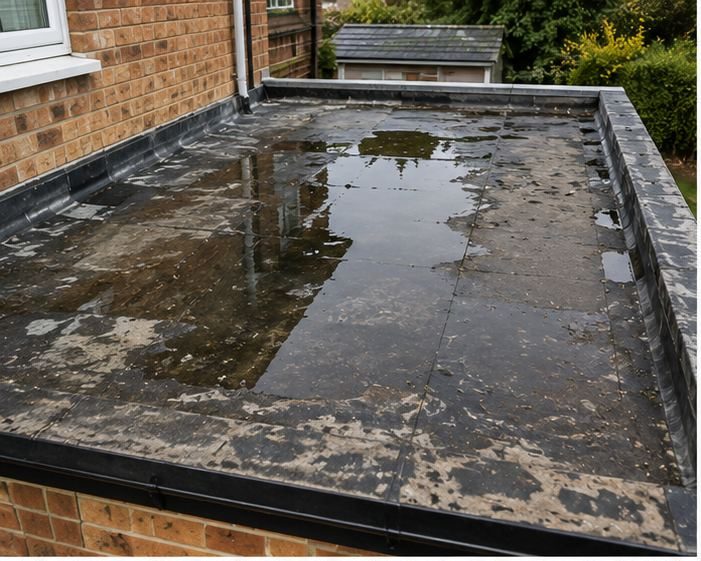
GRP, or fibreglass, is another system sometimes considered for extensions, offering a hard, rigid, walkable surface that some homeowners like for practical reasons, such as roof access for cleaning windows. However, GRP relies on a resin that can be more prone to cracking if the deck beneath it moves even slightly, and any repair typically requires matching and re-laminating the resin, which is a more involved process than patching a rubber membrane.
Traditional felt remains the cheapest option upfront, and can be perfectly adequate for a smaller, less exposed roof, but it generally has a shorter service life than EPDM and depends heavily on the quality of the seams between each layer of material. Felt roofs often need replacing well within 15 years, whereas EPDM is commonly guaranteed for 20 years or more, a difference that matters considerably over the full lifetime of an Emersons Green extension.
It is also worth thinking about how each system copes with the local climate over the seasons. Bristol's weather brings a fair mix of heavy rain, occasional strong winds and warm summer sun, and a covering that stays flexible and stable across that range without softening, cracking or degrading prematurely will simply give fewer problems over the years than one that struggles at either temperature extreme. EPDM's consistent performance across a wide temperature band is a genuine practical advantage in this respect.
The best system for any individual extension in Emersons Green also depends on the roof's specific shape and detailing. A simple rectangular roof with minimal penetrations suits any of these systems reasonably well, but an extension roof with a lantern rooflight, several pipe penetrations, or a complicated junction against the main house benefits particularly from EPDM's flexibility and the relative ease of dressing it around awkward details compared with the more rigid alternatives.
Insulation is another factor that should be considered alongside the choice of covering. A warm roof build-up, with insulation above the deck and the membrane on top, tends to perform better thermally and reduces the risk of condensation within the roof structure, which is worth discussing regardless of which covering system is chosen.
For most Emersons Green extensions, EPDM tends to offer the best overall balance of durability, flexibility and long-term value, though the right choice always depends on the specific roof and how it will be used. Brunel Roofing Bristol can look at your extension plans or existing roof and recommend the flat roofing system best suited to your project, with a clear explanation of why.
Get a Free Quote for EPDM Roofing in Emersons Green
Every roof is different — the fastest way to get an accurate answer is a quick chat with our team.