
Patchway has a good mix of housing, from established estates near the town centre to newer developments closer to the motorway network, and roofs across all of them can develop moss over time. Knowing when it is genuinely time to call in professional help, rather than just keeping an eye on it, is a common question we get asked by homeowners across the area, particularly once moss has become noticeable from ground level.
The clearest sign is visible growth that has moved beyond a light green tinge into distinct patches or clumps, particularly on shaded or north-facing slopes. Once moss has thickened into a dense mat rather than a thin covering, it is holding significantly more moisture against the tile surface, and that is when it starts to matter beyond simple appearance and becomes worth addressing properly.
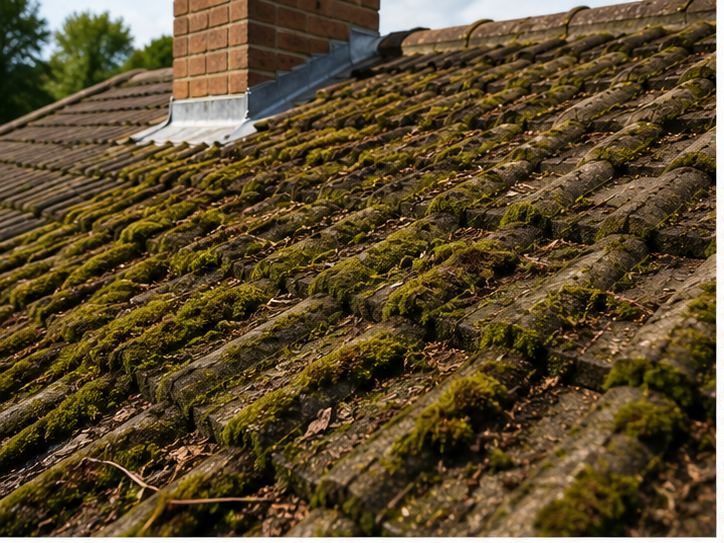
Another signal worth watching for on a Patchway roof is debris building up in the gutters. Moss breaks away in clumps as it grows and dries, washing down the roof slope during rain and often ending up blocking gutters at the eaves. If you are noticing more debris than usual collecting there, it is often a sign that moss on the roof above has reached a point worth addressing before it causes overflow.
The pitch and orientation of your particular roof plays a part too. Patchway properties with steeper or more shaded roof slopes, especially those near trees or with limited direct sun, tend to develop moss faster than open, south-facing roofs. If you know your roof falls into that category, it is worth checking on it more regularly rather than waiting for obvious problems to appear.
Age and condition of the roof covering matter as well. Older tiles that have lost some surface finish hold moisture more readily and tend to support moss growth faster than newer, smoother materials, meaning older Patchway properties can sometimes need attention sooner than a recently re-roofed house nearby with a similar amount of shade.
It is generally better to address moss while it is still relatively light rather than waiting until it has built up into a thick, established layer. Thinner growth is easier to treat gently and is less likely to have already caused any secondary issues, such as gutter blockages or moisture sitting against a tile for an extended period of time.
If you are the kind of homeowner who checks the roof only occasionally, it is worth building in a simple visual check from ground level a couple of times a year, particularly after autumn leaf fall and again after a wet winter, since these are the periods when moss tends to establish or thicken most noticeably.
It is also worth paying attention to how a roof compares to others nearby of a similar age and design. If a Patchway property is noticeably greener than its neighbours despite similar orientation, that is often a useful early sign that something about its particular conditions, whether shade, access to sunlight, or general condition, is encouraging faster moss growth than usual.
If you are unsure whether your Patchway roof needs professional attention, the simplest approach is to have it properly assessed rather than guess. Contact Brunel Roofing Bristol and we will take a look and give you an honest opinion on whether cleaning is worth doing now.
Get a Free Quote for Roof Cleaning in Patchway
Every roof is different — the fastest way to get an accurate answer is a quick chat with our team.