
Pucklechurch has a distinctly rural character, with many properties surrounded by mature trees, hedgerows and open countryside. While this setting is a large part of the village's appeal, it also creates ideal conditions for moss to establish itself on roofs, and it is one of the most common issues homeowners here ask us about.
Trees affect roofs in several ways at once. The most obvious is shade. A roof slope that sits beneath or close to overhanging branches receives far less direct sunlight than an open, unshaded roof, which means it stays damp for much longer after rain. Moss thrives in exactly these cool, moist conditions, so shaded slopes in Pucklechurch tend to develop noticeably heavier growth than sunnier ones on the same property.
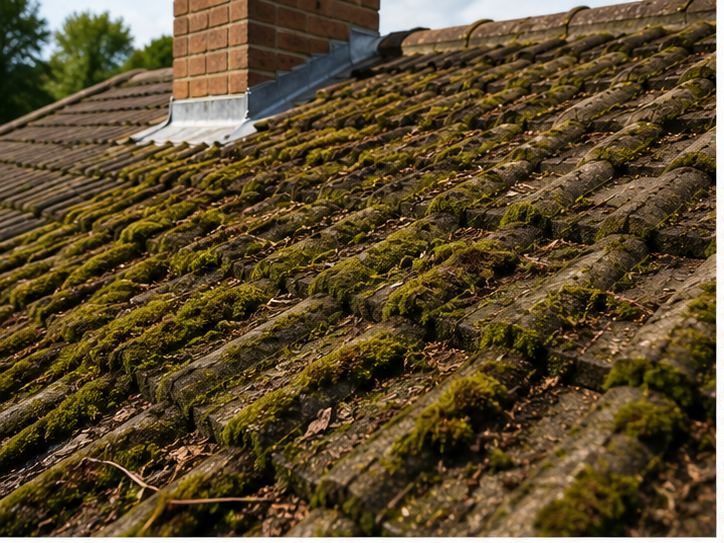
Falling leaves, seeds, blossom and small twigs are the other major factor. This organic material lands on the roof, particularly in gutters, valleys and around chimneys where it tends to collect rather than wash away, and as it breaks down it provides a steady supply of nutrients that helps moss spores establish and spread more quickly than they would on a bare, clean surface.
Trees also reduce airflow across a roof. Good air movement helps a roof surface dry out relatively quickly after rain, but a property enclosed by dense tree cover, as many are around Pucklechurch, loses much of that natural drying effect. The result is tiles that simply stay wetter for longer, day after day, which compounds the shade problem already described.
Older or lower-pitched roofs, common on some of the village's more established properties, are particularly susceptible, since a shallower pitch already allows more moisture to sit on the surface before it drains away, and tree cover on top of that only extends the problem further.
The variety of trees found around Pucklechurch also plays a part. Deciduous species that shed large volumes of leaves in autumn tend to deposit more organic debris onto nearby roofs than evergreens, though evergreens bring their own year-round shading effect that keeps a roof slope cooler and damper throughout every season rather than just in autumn. Properties bordering paddocks, orchards or larger gardens with a mix of tree types often see the combined effect of both.
Spring brings its own contribution in the form of pollen and blossom, which can coat a shaded roof slope in a fine layer that, combined with dew and light rain, creates a similarly favourable surface for spores to settle on. Even properties set back from the road on larger Pucklechurch plots, where trees line a driveway or boundary rather than overhang the house directly, can still see debris carried onto the roof by wind, so genuine distance from tree cover does not always guarantee a moss-free roof.
None of this means trees need to be removed to solve the issue, since they are often a valued part of a Pucklechurch garden. Sensible pruning to reduce direct overhang onto the roofline, combined with regular gutter clearance, can go a long way towards reducing how quickly moss returns after a proper clean.
If your Pucklechurch property sits near trees and moss has built up on the roof, Brunel Roofing Bristol can assess how much the surrounding vegetation is contributing and recommend the right cleaning approach along with practical advice for keeping growth under control afterwards.
Get a Free Quote for Roof Cleaning in Pucklechurch
Every roof is different — the fastest way to get an accurate answer is a quick chat with our team.