
On the terraced Georgian and Victorian properties that define much of Kingsdown, flat roof extensions and closet wings almost always meet a house wall at some point, and this junction is consistently one of the most important details to get right on any EPDM installation. Understanding why it matters so much helps explain what separates a roof that performs reliably for years from one that develops recurring problems.
At a wall junction, the EPDM membrane needs to turn upwards from the horizontal roof surface and be dressed against, or ideally tucked into, the brickwork above roof level, forming a continuous, watertight barrier. This change in direction, combined with the fact that two different building elements, roof and wall, are meeting at this point, makes it inherently more demanding to detail correctly than a flat, unbroken area of membrane.
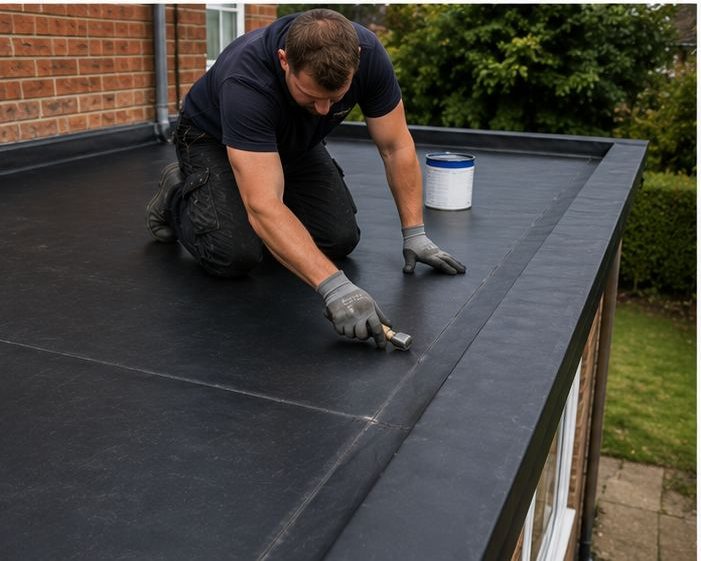
On Kingsdown's older properties specifically, wall junctions often carry additional complexity because the brickwork itself may be uneven, historically repaired, or have settled slightly differently to the roof structure over the many decades since the building was constructed. A junction that was detailed adequately when the property was newer can develop small gaps or vulnerabilities as this movement continues over time, which is why older junctions deserve particularly careful assessment.
A properly formed wall junction should see the EPDM membrane taken up the wall face to an adequate height and secured either into a chased line cut into the mortar joints or behind a suitably detailed flashing, rather than relying solely on a bead of sealant applied at the surface. Sealant alone tends to degrade with weathering over a period of years, and once it begins to crack, water can track behind the upstand and into the wall structure or roof below without necessarily being obvious from the outside.
Chimney breasts, a common feature on Kingsdown terraces, introduce similar junction challenges where the roof meets the base of the stack, often with additional corners that each need to be formed carefully in the membrane. Every corner effectively represents another opportunity for water ingress if it is not detailed and bonded properly, which is why chimney junctions on these properties warrant particular attention during installation.
The consequences of a poorly detailed wall junction are not always immediately obvious, since water can track behind an upstand and cause damp or timber decay well before it becomes visible as a leak inside the property. This is part of why so many older Kingsdown roofs that appear to have failed suddenly have, in reality, been letting water in gradually at a junction for some time beforehand.
The reassuring part is that wall junction failures are entirely preventable with correct detailing at the point of installation, and existing problem junctions can usually be properly repaired without needing to replace an entire roof, provided the surrounding membrane remains in good condition.
If you have a Kingsdown property with a flat roof showing signs of damp near a wall junction or chimney breast, Brunel Roofing Bristol can inspect that detail specifically, identify exactly what has gone wrong, and recommend the right fix for your building.
Get a Free Quote for EPDM Roofing in Kingsdown
Every roof is different — the fastest way to get an accurate answer is a quick chat with our team.