
Kingsweston sits right against some of the greenest, most established tree cover in this part of Bristol, with mature woodland around Kingsweston Down and Blaise Castle backing on to many of the streets nearby. That leafy setting is one of the reasons people love living here, but it is also exactly the sort of environment where roof moss thrives, and it is common for us to see roofs in Kingsweston with far heavier moss growth than similar properties on more open, sun-exposed streets.
Moss needs damp and shade to establish itself, and a roof overhung or partly shielded by trees rarely gets the chance to dry out properly, even between short spells of rain. North-facing slopes and any pitch that sits in shadow for most of the day stay cool and moist for longer, and that lingering dampness is enough to let moss spores take hold on the tile surface and start spreading.
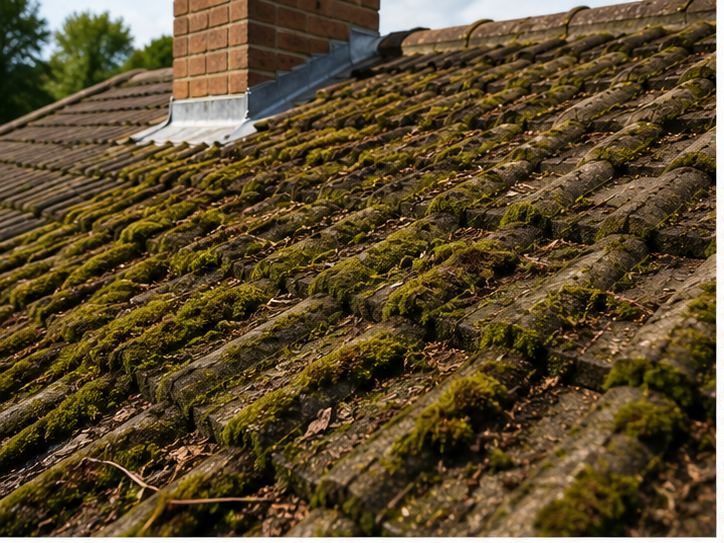
Trees add another factor beyond shade. Falling leaves, seeds, pollen and small twigs collect in roof valleys, against ridge tiles and around chimneys, breaking down over time into a fine organic layer that acts almost like compost for moss and algae. Once that debris builds up, it holds moisture against the tiles even longer and gives moss roots something soft to anchor into, which is why growth often starts in these pockets before spreading across a wider area of the roof.
The type and texture of the tiles themselves plays a part too. Older concrete and clay tiles, common on many Kingsweston properties, have a more porous, textured surface than newer manufactured tiles, giving moss spores more to grip on to. Once established, moss holds water against the tile like a sponge, which over time can affect the tile surface and, on some roofs, allow damp to work its way toward the timber structure beneath.
Left unchecked, moss does not stay confined to a small patch. It tends to thicken season by season, especially where a roof sits close to overhanging branches, and can encourage algae and lichen to establish alongside it. Beyond the cosmetic effect on a property's kerb appeal, thick moss growth adds weight to a roof slope and, as it breaks away in clumps, sends debris down into the gutters below.
Because the underlying cause in Kingsweston is so often the tree cover itself, tackling the moss on the roof is usually only part of the picture. Where practical, keeping nearby branches trimmed back and clear of the roofline helps reduce how quickly moss returns after a clean, alongside making sure gutters and valleys are kept free of the leaf litter that gives moss a foothold in the first place.
When we assess a mossy roof in Kingsweston, we look at which slopes are shaded, how close the tree cover is, and how the tiles themselves have held up before deciding on the right approach. We favour a gentle soft-wash and biocide treatment over aggressive high-pressure jet washing, since older or more porous tiles can be damaged by pressure washing and the growth is likely to return more quickly if the root structure isn't properly treated.
It also helps to recognise that not every mossy patch behaves the same way. A recently established colony near a chimney or valley may be shallow and relatively easy to treat, while an old, deeply rooted mat of moss on a permanently shaded slope has often had years to bed in, holding far more moisture and requiring a more thorough treatment to fully clear. Knowing the difference helps set realistic expectations for how a Kingsweston roof will respond once work begins, and how much visible change to expect in the weeks that follow.
If moss has built up on a shaded or tree-lined roof at your Kingsweston property, we would be glad to take a look and talk through a suitable, roof-safe cleaning approach along with a free quote.
Get a Free Quote for Roof Cleaning in Kingsweston
Every roof is different — the fastest way to get an accurate answer is a quick chat with our team.