
Walk down almost any street in Yate and you'll notice it fairly quickly: some roofs are thick with moss while others, sometimes right next door to each other, stay largely clear year after year. It isn't random at all, there are specific, identifiable reasons why certain roofs are far more prone to moss growth than others nearby with seemingly similar conditions.
Orientation is one of the biggest factors at play here. A north-facing roof slope gets considerably less direct sun through the course of the day than a south-facing one does, which means it dries out far more slowly after rainfall. That lingering dampness is exactly the environment moss needs in order to establish itself properly, so it's very common indeed to see moss concentrated heavily on one side of a roof while the other stays comparatively clean throughout the year.
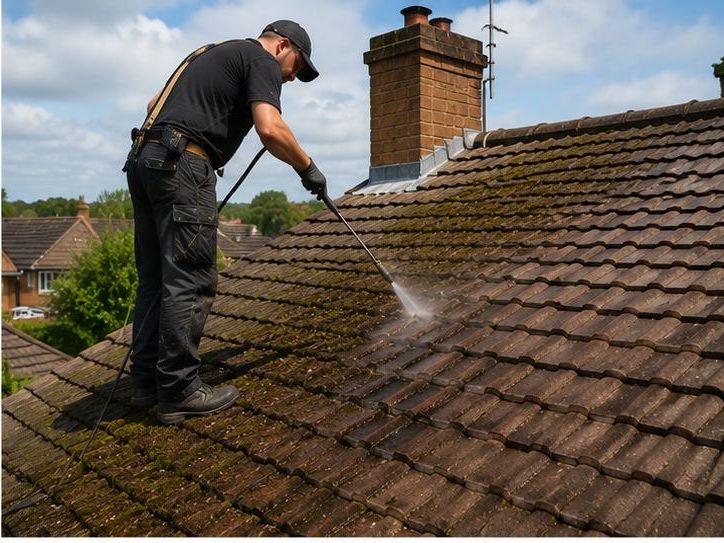
Tree cover plays a similarly large role in the picture too. Yate has a genuine mix of more established, tree-lined older streets and newer, more open modern developments, and roofs shaded by mature trees tend to develop moss noticeably faster and more thickly than those with a clear, sunny aspect and little overhead cover. Falling leaves and organic debris from those trees also settle steadily in valleys and against ridge lines, giving moss spores extra material to establish themselves on as the seasons pass.
The type and age of the roof tile itself matters considerably too, more than many people initially assume. Older concrete and clay tiles tend to have a more porous, textured surface than newer manufactured materials, giving moss spores something to grip onto far more easily and securely. This is part of why older properties in Yate often show more visible moss growth than recently built homes nearby, even when the two sit in fairly similar surroundings and get comparable amounts of daylight.
Pitch is another factor genuinely worth mentioning here as well. A shallow-pitched roof tends to hold moisture on its surface for considerably longer than a steep one, where rainwater runs off far more quickly and doesn't linger, which again creates more favourable conditions for moss to take hold and establish itself over time.
Once moss establishes itself in a particular spot on a roof, it tends to spread outward steadily from there, holding onto moisture and keeping the surrounding tile surface damp for longer than it would be otherwise, which helps it expand across the roof over successive seasons if it's simply left untreated and ignored.
It's also worth noting that neighbouring properties built at different times, or extended and altered over the years, can end up with quite different roofing materials side by side, which partly explains why moss coverage can vary so noticeably even along a single, otherwise uniform-looking street in Yate.
Understanding why one Yate roof has considerably more moss than the house next door is genuinely useful information, because it tells you what kind of ongoing maintenance rhythm that particular roof actually needs going forward, rather than simply treating every roof on the street the same way.
If you're not sure why moss keeps coming back on your roof in Yate, get in touch with Brunel Roofing Bristol and we'll take a proper look and explain clearly exactly what we're seeing. There's rarely a single simple cause, and more often it's a combination of orientation, tree cover and tile type working together, which is exactly why a proper on-site look tends to be far more useful than guessing from the street.
Get a Free Quote for Roof Cleaning in Yate
Every roof is different — the fastest way to get an accurate answer is a quick chat with our team.