
Arnos Vale is one of Bristol's greener suburbs, with mature trees lining many of its streets and backing onto gardens around the cemetery and nearby open spaces. That greenery is one of the area's real charms, but it is also exactly the kind of environment in which roof moss thrives.
Moss needs damp, shaded conditions to establish itself, and overhanging branches provide precisely that. Tree cover blocks direct sunlight from reaching the roof surface, keeping tiles cooler and slower to dry out after rain. On a north-facing slope shielded further by a neighbouring tree, a roof in Arnos Vale can stay damp for far longer than an equivalent roof on a more open, sun-exposed street.
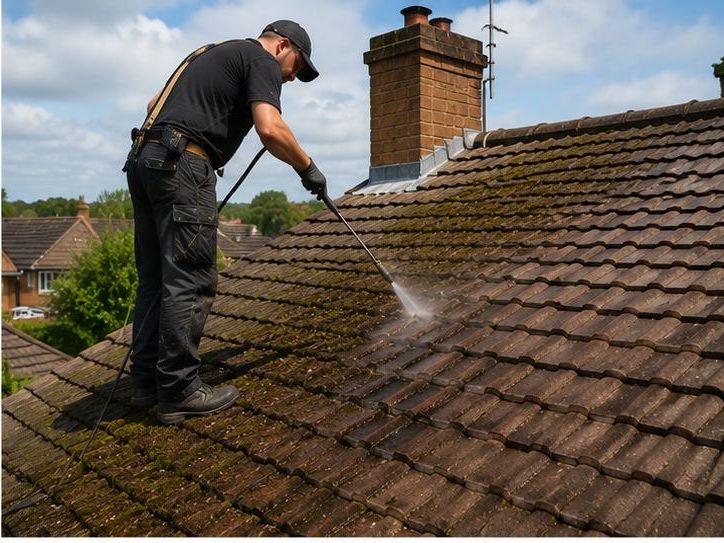
Humidity trapped close to ground level by dense tree cover can add to the effect too, particularly in gardens backing onto larger stands of trees near the cemetery grounds. Even on days without direct rainfall, a roof shaded and enclosed by mature trees can retain more ambient moisture in the air immediately around it than an equivalent roof on a more open, breezier street, which slows drying further still and gives moss one more small advantage in an already favourable setting.
Trees contribute in a second, less obvious way too. Falling leaves, blossom, pollen and small twigs settle on roof surfaces and in valleys, gradually breaking down into an organic layer that acts almost like compost. This debris holds moisture against the tiles and gives moss spores an easy foothold, which is why roofs near mature trees often show noticeably heavier growth than roofs just a few doors away that sit in more open positions.
Older roof coverings play a part as well. Many Arnos Vale properties have roofs that are decades old, with a slightly rougher, more porous tile surface than modern coverings. That texture gives moss spores something to grip onto, whereas smoother or newer tiles tend to shed growth more easily. Combine an older roof with heavy tree shade and you have close to ideal conditions for moss to spread.
It is worth saying that moss on a tree-shaded roof is not necessarily a sign of poor maintenance, it is simply a product of the local environment. That said, once moss becomes established it does not stay put. It spreads across the tile surface, retains moisture against the roof covering, and over time can contribute to the kind of gradual deterioration that is far easier to prevent than to repair.
For homes in these leafier pockets of Arnos Vale, it can be worth having roofs checked slightly more often than a property on a fully open, sun-exposed street, simply because the conditions favour regrowth. A soft-wash biocide treatment, rather than harsh jet washing, is generally the more appropriate approach for these older, moisture-prone coverings, since it deals with the moss without stripping or damaging the tile surface.
There is also a seasonal rhythm to this that Arnos Vale residents with tree-shaded roofs tend to notice over time. Growth often accelerates through the wetter autumn and winter months, when both shade and rainfall are at their combined peak, and can appear to slow slightly during drier summer spells, only for the underlying cushion of moss to still be there, ready to spread again once the weather turns. Recognising this pattern helps in planning maintenance sensibly, rather than assuming a quieter-looking roof in July means the problem has resolved itself.
If your Arnos Vale property sits beneath tree cover and you have noticed moss creeping back year after year, it is worth having someone take a proper look rather than guessing at the cause. Brunel Roofing Bristol would be glad to assess your roof and talk through the most sensible way to tackle it for your particular setting.
Get a Free Quote for Roof Cleaning in Arnos Vale
Every roof is different — the fastest way to get an accurate answer is a quick chat with our team.