
An abutment is any point where a roof slope meets a vertical surface, most commonly a chimney stack, a party wall, or the wall of a rear extension. Many of the older properties dotted around Chipping Sodbury have at least one chimney, and it is the flashing around that chimney, more than the tiles themselves, that usually decides whether the roof stays watertight in that area for years to come.
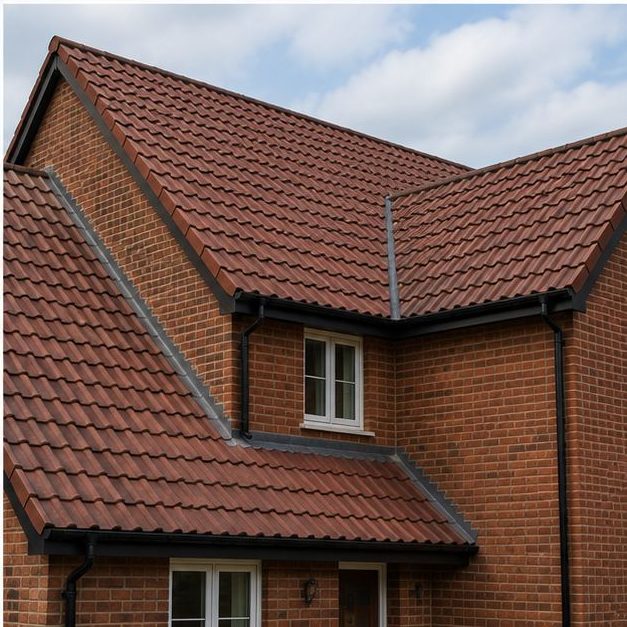
Flashing works by covering the gap between the roof and the wall, directing water down and away rather than allowing it to run into the joint. Around a chimney, this normally means a set of stepped flashings up each side, a soaker tray or back gutter behind the stack to catch water running down from above, and a front apron below. Each piece needs to be the right size, correctly lapped, and properly dressed or pointed into the brickwork joints so there is no gap for water to exploit.
The material used matters as much as the method. Code 4 or Code 5 lead is the standard choice for chimney and abutment flashing because it can be dressed tightly into brickwork and will last for decades if installed correctly. Cheaper substitute materials, or flashing that has simply been sealed on top of the roof surface with mastic rather than properly dressed into the wall, tend to fail far sooner, often within just a few years.
Because flashing sits at a junction rather than across an open roof plane, a failure there rarely announces itself as dramatically as a missing tile. Instead it shows up as a slow, recurring damp patch near a chimney breast inside the house, which can be mistaken for condensation or a different problem entirely until the roof is actually inspected.
Abutments are not only found around chimneys. Many Chipping Sodbury properties have single-storey extensions, garages, or bay windows where a lower roof meets a higher wall, and these abutments need exactly the same care with flashing as a chimney does. Because these lower roofs are often less visible from ground level, their flashing can be neglected for longer, which sometimes means the damage found there is more advanced by the time it is noticed.
Maintenance also plays a part in how long flashing lasts. Lead can be dislodged by falling branches, disturbed by birds, or knocked out of position during unrelated work such as chimney sweeping or aerial installation, so it is worth having flashing checked periodically even outside of a full re-roof, particularly after any work has taken place near a chimney or abutment.
When a roof is replaced, the flashing around every abutment should be renewed properly rather than reused or patched, since it is one of the details that has the biggest impact on how long the new roof performs well. Brunel Roofing Bristol fits proper lead flashing around chimneys and abutments on every re-roof we carry out in Chipping Sodbury. Get in touch if you would like a survey of your own roof's flashing.
Get a Free Quote for New Roof Installations in Chipping Sodbury
Every roof is different — the fastest way to get an accurate answer is a quick chat with our team.