
Damp patches appearing on a chimney breast or ceiling are one of the more common calls we get from homeowners in Bishopsworth, and the short answer is yes, a leaking chimney absolutely can be the cause, sometimes in ways that are not obvious at first glance. Because a chimney stack passes straight through the roof and often down through multiple floors of a house, a fault at the very top can produce a damp patch a surprising distance away from where the water is actually getting in.
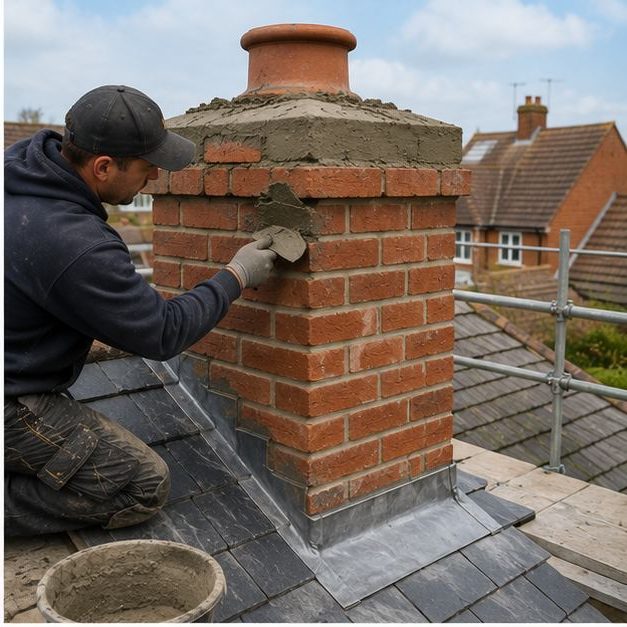
The most common entry points are at the junctions rather than the flat faces of brickwork. Lead flashing and soakers, fitted where the stack passes through the roof covering, are designed to shed water around the chimney rather than letting it track down the join, but flashing that has lifted, split with age, or been dislodged in a storm creates a direct route for rainwater to get behind the roofline and into the structure below. Cracked flaunching at the top of the stack does something similar from above, letting water in around the base of the pot and down inside the flue itself. Even where the flashing looks intact from a distance, age and repeated thermal movement can open tiny gaps at the joints and folds that are only obvious on close inspection.
Porous or spalling brickwork adds a third route. Bricks that have started to crack and flake at the surface, often after years of repeated freeze-thaw damage, absorb far more water than sound brickwork, and in a wet spell that moisture can work its way through the wall thickness and appear as staining or damp on an internal chimney breast. This is particularly common on older solid-wall properties in Bishopsworth built before cavity construction became standard.
One of the trickier aspects of chimney-related damp is that the stain indoors is not always directly below the fault. Water can travel sideways along a timber or through a construction gap before it shows itself, which is why a patch of damp on a bedroom ceiling might actually trace back to flashing or brickwork some distance away on the stack. Proper diagnosis usually means tracing the path rather than assuming the visible stain sits right under the source. Older properties with solid, uninsulated walls are particularly susceptible to this, since there is less of a cavity to slow moisture down before it reaches an interior surface.
It is also worth remembering that a disused or capped chimney is not automatically immune to this. An unused flue with a poorly fitted cap, or none at all, can still let rain track in and cause exactly the same damp problems even though there is no fire ever lit beneath it. A simple, correctly fitted cowl or cap often resolves this cheaply once the chimney itself has been confirmed sound.
If you are seeing damp staining anywhere near a chimney breast in your Bishopsworth home, it is worth having the stack, flashing and flaunching checked before assuming the cause lies elsewhere in the property. Brunel Roofing Bristol offers free inspections that trace the actual source rather than guessing, with repairs backed by a 15-year guarantee.
Get a Free Quote for Chimney Repairs in Bishopsworth
Every chimney is different — the fastest way to get an accurate answer is a quick chat with our team.