
Where a chimney stack meets the roof slope, it is almost always lead flashing — not the tiles or the brickwork — doing the real work of keeping water out, and it is one of the most common sources of leaks on Pucklechurch properties precisely because it is so easy to overlook. The flashing forms a weatherproof seal around the base of the stack, and when it fails, water can get in without a single roof tile being damaged or out of place.
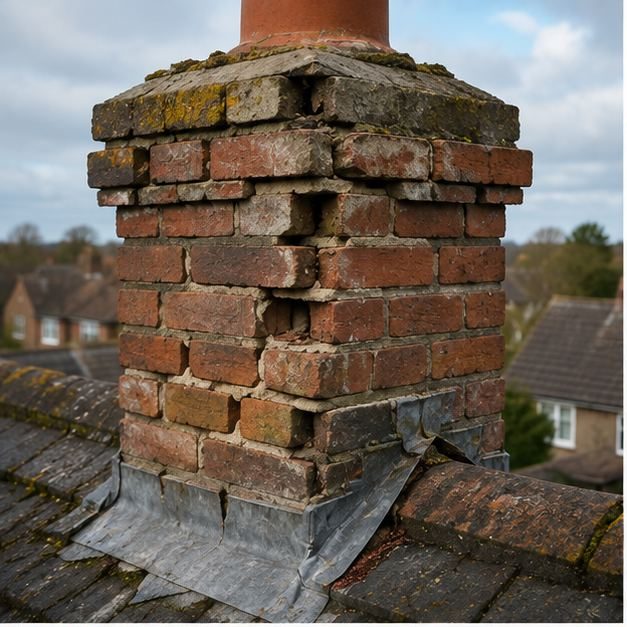
Lead has a long working life, but it is not indestructible. It can crack with age and thermal movement, lift at the edges where it was originally dressed into the brick joints, or simply be dislodged by wind or by birds and squirrels working at the edges. Soakers, the individual pieces of lead woven between tiles at the sides of a stack, and the back gutter, which channels water around the uphill side of a chimney, are just as prone to failure and are often the actual point of ingress even when a leak appears to be coming from somewhere else entirely.
This is part of what makes flashing problems tricky to diagnose without a proper inspection: a damp patch on a ceiling can be some distance from where water is actually getting in, since it can travel along roof timbers or run down the inside face of a chimney breast before showing itself. Anyone in Pucklechurch dealing with an intermittent leak that seems to appear only in heavy rain, or only when wind is driving from a particular direction, should treat chimney flashing as a prime suspect, well before assuming the tiles themselves are at fault.
Repairs range from re-dressing lifted lead back into its joint and re-pointing the lead into the brickwork, through to full replacement of the flashing, soakers and back gutter where the lead has genuinely reached the end of its life or where an older repair was done poorly with an unsuitable material. Code 4 or Code 5 lead, correctly specified for the exposure of the stack, tends to give the most reliable long-term result on Pucklechurch's mix of house types, and is worth insisting on over cheaper alternatives that will not last as long.
Because this work is done at height and involves careful dressing of lead into brick joints, it benefits from being carried out methodically rather than rushed, and it is worth having any existing flashing checked whenever other roof or chimney work is being done, since it is far cheaper to address alongside other access than to arrange separately later.
If you have noticed a leak near a chimney breast in your Pucklechurch home, or simply want ageing flashing checked before it becomes a problem, Brunel Roofing Bristol offers free inspections and can trace the actual source of water ingress rather than guessing, with a 15-year guarantee on completed repairs and 24-hour emergency call-out for anything urgent.
Get a Free Quote for Chimney Repairs in Pucklechurch
Every chimney is different — the fastest way to get an accurate answer is a quick chat with our team.