
When a chimney starts letting water into the loft or a bedroom ceiling near the chimney breast, brickwork is often blamed first, but in a large proportion of cases the actual culprit is the lead flashing around the base of the stack rather than the masonry itself. Around The Downs, where stacks are exposed to persistent wind-driven rain, lead components tend to work loose or corrode sooner than they would on more sheltered roofs, making leadwork one of the more frequent chimney repairs we carry out in this part of the city. In some cases what looks like a chimney problem from inside the house turns out to be nothing to do with the brickwork at all once the flashing is properly examined.
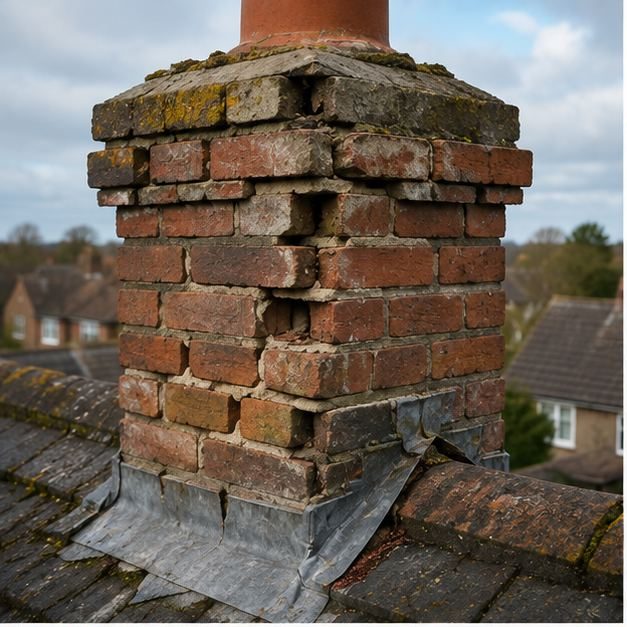
Lead flashing forms the watertight junction between the chimney and the surrounding roof covering, and it's made up of several separate pieces — stepped flashing along the sides, soakers tucked beneath each course of tiles or slates, and a back gutter positioned above the stack to divert water around it rather than letting it pool against the brickwork. Any one of these failing, whether through corrosion, movement, or simply coming loose from the wall over time, can let water in even when the chimney itself is otherwise sound and the pointing is in good condition.
The back gutter is particularly important on wider stacks, since it channels rainwater running down the roof above the chimney away to either side. If it splits, corrodes, or was undersized to begin with, water can back up during heavy rain and find its way into the roof space, sometimes appearing as damp well away from the chimney itself, which makes the source easy to misdiagnose without a proper inspection of the whole junction rather than just the visible parts of the stack.
Good quality lead, correctly dressed into the joints and properly fixed rather than simply relying on sealant, should last for many years even in an exposed position like this. Where we find flashing has failed prematurely, it's often down to poor original installation or ageing lead that's simply reached the end of its life, rather than anything the homeowner has done wrong, though repeated sealant patching over the years can also mask a problem that's actually getting worse underneath. Sealant alone should never be treated as a permanent fix on a stack this exposed, since it degrades in UV light and temperature swings far faster than properly dressed lead.
Replacing flashing properly means stripping back the old lead and any failed sealant entirely, then dressing new lead into the brickwork joints and interleaving it correctly with the roof covering, rather than laying a sheet over the top and sealing the edges. This matters particularly around the back gutter, where a poorly formed junction is one of the more common reasons a repaired area starts leaking again within a year or two.
If you've noticed a leak connected to your chimney, or simply want the leadwork checked before the wetter months set in, Brunel Roofing Bristol can inspect and repair flashing, soakers and back gutters on properties around The Downs, with all leadwork covered by our 15-year guarantee and 24-hour emergency call-out available for anything urgent.
Get a Free Quote for Chimney Repairs in The Downs
Every chimney is different — the fastest way to get an accurate answer is a quick chat with our team.