
Leadwork around a chimney does a job that's easy to take for granted precisely because, when it's working properly, nobody ever notices it. On Easton's terraced housing, where roofs often have a single chimney stack passing through a fairly standard pitched roof, three main pieces of leadwork, flashing, soakers and a back gutter, work together to keep that junction watertight in all but the most extreme weather. Few homeowners think about leadwork in this level of detail until a leak forces the question, but understanding the basics makes conversations with a roofer considerably more productive.
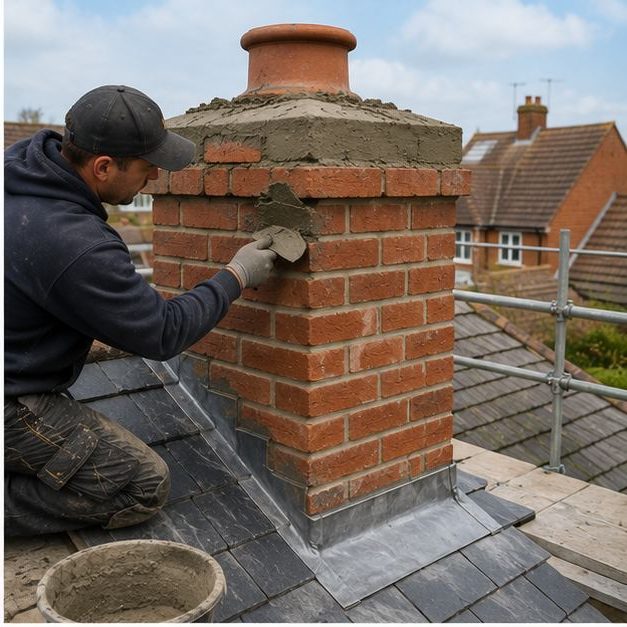
Flashing is the most visible piece, dressed against the brickwork of the stack and lapped over the roof covering to stop water tracking in at the join. It's usually the first thing people picture when leadwork is mentioned, and on many Easton properties it's also the piece most likely to fail first, since it takes the brunt of weather exposure directly against the brick above it. Understanding which piece is which also helps homeowners make sense of a quote or report that references specific leadwork components, rather than treating the whole system as one unexplained item.
Soakers work less visibly, tucked individually beneath each course of tile or slate along the sides of the chimney, directing water outward and down rather than letting it seep sideways into the roof structure. Because they're hidden beneath the roof covering, a failed soaker often isn't obvious until a leak has already been running for some time, sometimes only discovered once other leadwork is being repaired and the covering is lifted to inspect underneath properly.
The back gutter, positioned on the upslope side of the chimney where rainwater running down the roof would otherwise pool against the stack, is arguably the hardest-working piece of the three. A cracked or undersized back gutter can cause a persistent leak even when the flashing around the rest of the stack looks perfectly sound, which is why diagnosing a leak properly means checking all three elements rather than assuming the most visible one is automatically the culprit responsible.
On older properties across Easton, it's common for one piece of this system to have been replaced at some point while the others remain original, simply because whichever failed first got attention while the rest were still holding up at the time. Checking the whole system together, rather than the piece that's currently causing a visible problem, tends to prevent a repeat call-out a year or two later. Where a roof has more than one abutment or junction, each one effectively needs its own leadwork assessment, since a fault at one point rarely indicates the condition of another elsewhere on the same roof.
If you're dealing with a chimney leak in Easton, Brunel Roofing Bristol can inspect the full leadwork system around the stack and identify exactly what needs repair or replacement, with a free quote and 15-year guarantee on the finished work.
Get a Free Quote for Chimney Repairs in Easton
Every chimney is different — the fastest way to get an accurate answer is a quick chat with our team.