
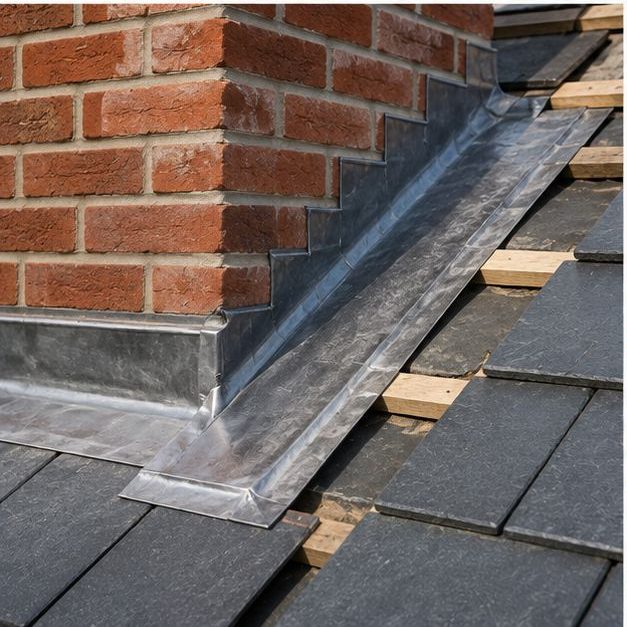
Of all the components on a chimney stack, the leadwork is arguably doing the most unforgiving job. Where the stack meets the roof, flashing and soakers form the seal that keeps water out of what would otherwise be one of the most vulnerable junctions on the entire roof, and when that seal starts to fail, the consequences show up inside the house long before the leadwork itself looks obviously damaged from the ground, which is what makes it such an easy problem to miss.
For Shirehampton homeowners, leadwork problems often first appear as a damp patch on a ceiling or the top of a wall near a chimney breast. It's worth knowing that the leak indoors is not always directly below the point where water is actually getting in; it can travel along timber or the underside of the roofing felt before showing itself, which means a proper trace-back to the chimney is more useful than treating the visible stain in isolation and hoping it doesn't return. This is why an experienced roofer will often start at the chimney rather than the ceiling when investigating a reported leak.
Flashing failure tends to happen gradually. Lead can work loose from the mortar joint it's dressed into as the roof and chimney move slightly with weather and temperature changes over the years, and older installations using thinner-gauge lead than would be used today are naturally more prone to splitting or corroding over time. Soakers, the small individual pieces of lead fitted between tiles at the sides of a stack, can also shift or corrode independently of the main flashing, which is why a full leadwork check covers more than just the visible flashing strip.
Repairing leadwork generally means either re-dressing existing lead back into cleaned and repointed joints, or replacing sections that have deteriorated beyond a simple repair. Because this work happens at roof level, safe access is essential, and it's a job best left to someone equipped to work at height properly rather than attempted from a ladder propped against the guttering. Getting a proper look at the lead close up also reveals whether it's a localised repair or something that needs replacing across the whole stack.
Leadwork problems rarely announce themselves suddenly; they tend to worsen slowly across several wet seasons, which is exactly why they're often more advanced than expected by the time someone notices a leak inside, and why a check every few years is worth doing even without an obvious symptom prompting it. Catching a small split or a slightly lifted edge early on is a straightforward repair compared with the work needed once water has been getting in unnoticed for a year or more.
If you've spotted a damp patch near a chimney breast in your Shirehampton home, or it's simply been a while since the leadwork was checked, Brunel Roofing Bristol can inspect it as part of a free, no-obligation quote.
Get a Free Quote for Chimney Repairs in Shirehampton
Every chimney is different — the fastest way to get an accurate answer is a quick chat with our team.