
Mortar is the part of a chimney that takes the brunt of weathering, and by design — it is meant to be the sacrificial layer, softer than the brick it holds together, so that it wears away over the decades rather than the brick itself. Thinking of mortar as a deliberately replaceable, sacrificial part of the structure helps explain why repointing every so often is entirely normal rather than a sign of poor original workmanship. That is exactly why repointing exists as a routine repair rather than a sign that something has gone badly wrong.
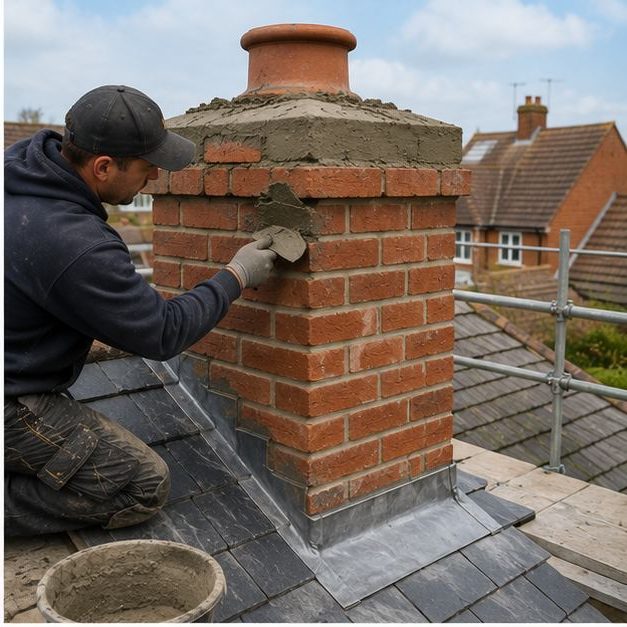
The process is gradual. Rain, frost, and years of thermal cycling slowly wash out and crumble the surface of the mortar between the bricks, and a joint that once sat flush with the brick face ends up recessed, then eventually crumbly enough to pick out with a fingernail. Because a chimney stack is more exposed to the weather than most of the rest of a roof, its mortar tends to weather faster than mortar elsewhere on the same property, which is why chimneys are often the first part of a Filton roofline to need repointing even when the rest of the roof is in decent shape. It is a useful rule of thumb to check the chimney specifically rather than judging the whole roof's condition from the tiles alone.
The signs are usually visible from ground level if you know what to look for: dark recessed lines between bricks where mortar has washed out, small chunks of mortar debris on the roof or in the guttering below the stack, or in more advanced cases, visible gaps you can see daylight through. None of these need to cause alarm on their own, but they are a reasonably clear signal that repointing is due before the problem progresses to affecting the brick itself.
Proper repointing means raking out the failed mortar to a sufficient depth — not simply smearing new mortar over the old, which tends to fail quickly since it has nothing solid to key into — and repacking the joint with a mix suited to the age and type of brick. Older brick generally calls for a lime-based mortar that can flex with the brickwork, while more modern brick usually takes a cement-based mix comfortably. Getting this choice wrong is one of the more avoidable mistakes in chimney repair, and one worth checking with whoever is quoting the job.
Left too long, weathered mortar stops being a straightforward repointing job and starts letting water penetrate into the stack itself, which is where the more expensive problems — spalling brick, water ingress, structural movement — tend to begin.
If your chimney's mortar is looking recessed or worn, Brunel Roofing Bristol can assess it and repoint using the correct mix for your brick type, backed by our 15-year guarantee. Free inspections are available across Filton.
Get a Free Quote for Chimney Repairs in Filton
Every chimney is different — the fastest way to get an accurate answer is a quick chat with our team.