
Lead flashing does a quietly important job around any chimney, sealing the junction between the stack and the roof covering where two very different materials meet. On older properties in Chipping Sodbury it's common to find flashing that's decades old, and while lead is a genuinely durable material, it doesn't last forever, and knowing when to patch it versus replace it outright can save both money and repeated call-outs over the following years. Understanding the difference between a genuinely serviceable repair and a temporary fix that's likely to fail again soon is one of the more valuable things a homeowner can learn about their own roof.
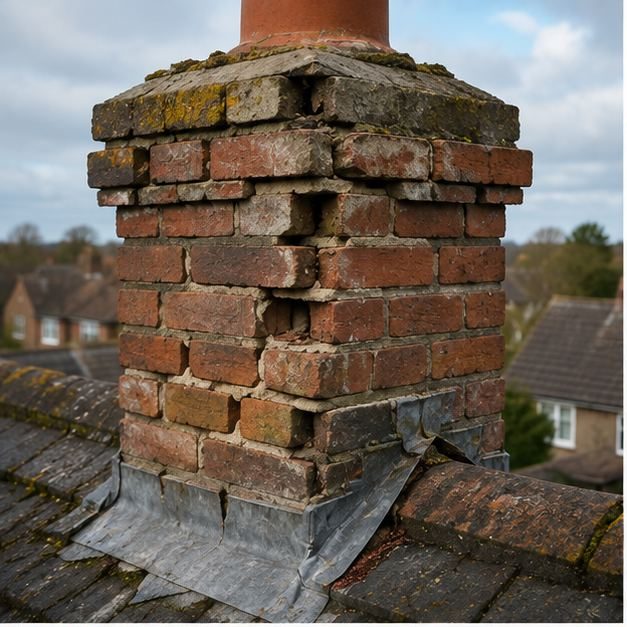
Small, localised failures are often good candidates for repair. A short section of lifted flashing, a minor split, or flashing that has come away from its chase joint in one spot can often be re-dressed, re-secured or patched without disturbing the rest of the installation, provided the surrounding lead is still in reasonably sound condition and hasn't already begun to fatigue elsewhere along the same run. A competent roofer should be able to tell fairly quickly, by examining the lead's flexibility and thickness in person, whether a patch is likely to hold for the medium term.
Full replacement tends to make more sense once the lead has become brittle, is cracking in multiple places, or has been patched repeatedly over the years to the point where further patching is really just delaying the inevitable. Lead that has thinned significantly through weathering, or that was undersized or poorly fitted originally, rarely gives good long-term results from spot repairs alone, and a false economy here tends to cost more in the long run than doing the job properly once.
There's also a practical scaffolding consideration. If access equipment already needs to go up for other chimney work, such as repointing or flaunching repair, it's often more cost-effective in Chipping Sodbury to replace ageing flashing at the same time rather than paying for scaffolding again in a few years when a patch inevitably fails and the whole job has to start over.
Signs that flashing has already failed usually show up as damp staining just below the chimney inside the loft, or occasionally lower down if water has tracked along a rafter before dripping. Because that staining doesn't always appear directly under the fault, it's worth having the flashing itself inspected rather than assuming the leak's exact source from the ceiling mark alone, particularly on a roof with more than one chimney or a complex junction. Discolouration or a chalky white residue on the lead's surface can also be an early indicator worth mentioning to whoever carries out the inspection, even if it doesn't look dramatic in itself.
If you've noticed staining, or simply know your flashing is old and haven't had it checked, Brunel Roofing Bristol can assess it and give you an honest recommendation, patch or replace, backed by a free quote and our 15-year guarantee on completed work.
Get a Free Quote for Chimney Repairs in Chipping Sodbury
Every chimney is different — the fastest way to get an accurate answer is a quick chat with our team.