
Downend's mix of Victorian and Edwardian terraces, inter-war semis and later estates brings a mix of faults too, and the many extensions and loft conversions add some of their own.
Roofs in Downend are not all alike. The housing runs from older terraces to inter-war semis and later estates, and a good many have been extended or had the loft converted. That variety means the common problems depend on the age of the roof and what has been added since, but a handful appear again and again. We deal with all of them.
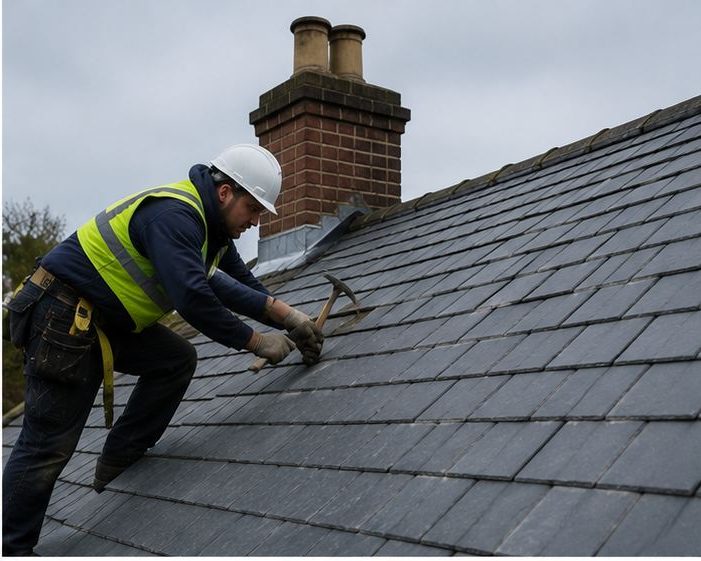
Slipped, cracked and missing tiles
Tiles move with age, frost and wind, and fixings weaken. A slipped or cracked tile lets water reach the felt, and a few can be the start of a larger leak. On older terraces, original coverings have often had many patch repairs. We look at whether the odd tile is the issue or whether the covering as a whole is tired. Older terraces tend to show the most. Frost in particular loosens old fixings gradually, so the damage shows up a little at a time.
Ridge, hip and verge mortar
Ridge and hip tiles are bedded in mortar, and so are many verges. Mortar cracks and falls out, leaving loose tiles and open gaps. Crumbs on paths and drives are a typical first sign. We re-bed ridges and hips, and where it suits the roof, a dry verge replaces failed verge mortar with mechanically fixed pieces. Later estates are less prone, but not exempt. Wind then catches the loose pieces and moves them.
Flat roofs on extensions and add-ons
Extensions, garages, porches and dormers often have flat roofs, and these show ponding, blisters, splits and failed joints where they meet older walls. A repair is sensible where the deck is sound; replacement where failure is widespread. Common trouble spots across the area include these: A repair now is often far less disruptive than a rebuild later.
- Flat roofs with poor falls or blocked outlets
- Junctions between extension roofs and older walls
- Flashings around roof windows and dormers
- Gutters and fascias showing rot or leaks
- Moss build-up on shaded slopes
Gutters, fascias and soffits
Leaking gutters soak fascia boards, which rot where water sits. Replacing them with UPVC fascias and vented soffits is a common job. Blocked gutters also send water down walls, damaging brickwork and causing damp inside. Often the fix is an overdue tidy-up rather than a major job. Mortar and gutters are usually among the first to be missed. Overflowing water also marks walls.
What to do next
Look from the ground for slipped tiles, sagging gutters, stains and mortar crumbs, and inside the loft for damp or daylight. Please do not go onto the roof. Call us for a proper look, and we will tell you what is urgent and what can wait. We tell you plainly what matters most.
Frequently Asked Questions
What is the single most common problem?
It varies, but failed mortar on ridges, hips and verges, slipped tiles and tired flat roofs on extensions come up regularly. Gutters and fascias are a close companion, since they fail together with water. We list what we find. Gutter faults are among the commonest.
Are loft conversions prone to roof problems?
The details are what matter. Roof windows, dormers and new junctions add flashings that must stay sound. Most problems come from those joints, not from the conversion itself, and they are easy to inspect. They are easy to inspect. A quick look from the ground can help.
Do newer estates have fewer roofing problems?
They often have fewer age-related faults, but not none. Mortar at ridges and verges, fixings and gutters can still need attention. We check each roof on its own condition. Age is not the only factor. A mix of ages means a mix of faults.
Talk to our team about general roofing services in Downend
Every roof is different — the fastest way to get an accurate answer is a quick chat with our team.