
When heavy rain finds its way into a home, the instinct is often to look straight up from the damp patch on the ceiling for an explanation. In practice, water can travel a surprising distance along rafters, battens or the underside of roofing felt before it drips down at a point well away from where it actually entered, which is why tracing a leak accurately on an Eastville property usually takes more than a quick look from below. A leak that only appears after several hours of continuous rain, rather than during a brief shower, is often a strong clue that the entry point is a slow seep rather than an obvious gap.
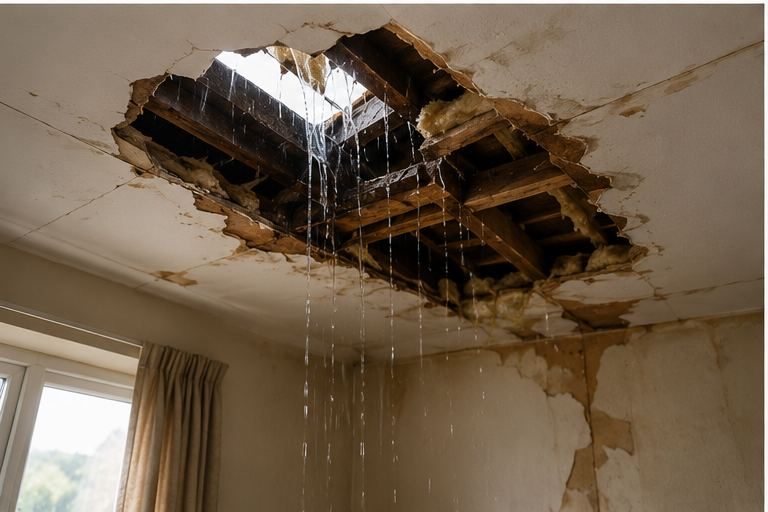
Chimney flashing is one of the most frequent culprits during prolonged heavy rain. The seal between a chimney stack and the surrounding roof relies on flashing staying continuously bonded to the brickwork, and even a small gap, invisible from the ground, can let a steady trickle of water in once rain has been falling for hours rather than minutes. Similarly, valleys where two roof slopes meet can overflow if partially blocked, sending water sideways under nearby tiles rather than straight down the channel, particularly where leaves and debris have been allowed to build up unnoticed over a longer period.
Roof edges and verges are another common entry point, particularly on older properties across Eastville where mortar pointing has started to deteriorate. Once this seal is compromised, sustained heavy rain, rather than a single sharp gust, tends to be the trigger, since it gives water enough time to work its way behind tiles that would otherwise shed a brief shower without issue. Flat roof sections on rear extensions can behave similarly, with ponding water eventually finding a weak seam that a shorter spell of rain would never have tested.
Individual slipped or cracked tiles are a more obvious cause, but even here the path water takes once inside the roof structure is not always straight down. It can run along the felt beneath the tiles until it reaches a join, a nail hole, or a low point, before finally dripping through, which is why a leak sometimes seems to appear in an unexpected room during a long spell of rain.
Because the true source of a leak is often some distance from where it shows up indoors, tracing it properly usually means someone getting onto the roof itself to check flashing, valleys, edges and individual tiles methodically, rather than guessing based on the position of the damp patch. Trying to fix the visible symptom without finding the actual entry point tends to mean the leak simply returns during the next heavy downpour.
If your Eastville home has developed a leak during recent heavy rain, Brunel Roofing Bristol can carry out a proper inspection to identify exactly where water is getting in and provide a free quote for putting it right, rather than leaving you to guess at the cause.
Need Emergency Roof Repairs in Eastville?
Every case is different — the fastest way to get an accurate answer is a quick chat with our team.