
Wind doesn't put even pressure across a whole roof. It concentrates its force at specific points, and understanding which parts of a Brentry property are most exposed helps explain why storm damage so often appears in the same handful of locations rather than spread randomly across the whole roof surface.
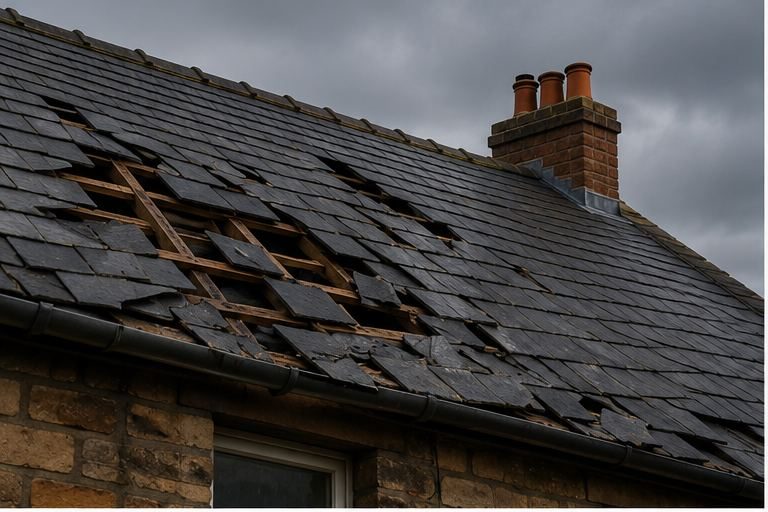
Ridges and hips, sitting at the highest points of the roof, take some of the most direct wind pressure of any section, particularly where mortar bedding has aged and lost some of its original bond over years of exposure. Verges, the edges where a pitched roof meets a gable wall, are similarly exposed, since wind pressure tends to build up and concentrate along these edges rather than dissipating evenly across a flat slope in the way it might on a more sheltered part of the roof.
Corners and roof edges more generally are also disproportionately vulnerable, a fact well understood in roofing even if it isn't obvious from the ground. Wind moving over and around a building creates areas of increased suction right at the edges and corners of the roof, which is why it's common to see damage concentrated at one corner of a property while the main body of the roof remains completely untouched by the same storm. Chimneys present their own particular vulnerability, both because the flashing around the base can be pulled or stressed by wind, and because a tall chimney stack acts almost like a sail, channelling additional wind force down onto the surrounding roof area during a genuinely severe gust, putting extra strain on the tiles and flashing immediately around its base.
Flat-roofed extensions, dormers and porches are vulnerable in a different way, since strong wind can get under a covering that's already slightly lifted at an edge or seam and peel it back further, an effect that's more likely where a covering is ageing or wasn't perfectly bonded during a previous installation. Guttering and roofline details can also suffer in the same conditions, particularly where brackets have loosened gradually over time.
Some Brentry properties, particularly the taller, older houses found on certain streets, add a further consideration: height itself increases wind loading, meaning ridges and chimneys on a taller building can be exposed to noticeably stronger gusts than the same details on a lower, more sheltered property nearby. Knowing where to look doesn't remove the need for a proper inspection, since damage at height often isn't visible from the ground even when you know exactly which areas to check, but it does help homeowners understand why a roofer's assessment tends to focus on these specific spots rather than scanning the whole roof evenly.
If a storm has passed through Brentry and you're wondering whether these vulnerable points on your own roof have held up, Brunel Roofing Bristol offers free inspections that specifically check ridges, verges, chimneys and edges, the areas most likely to show the first signs of wind damage.
Need Emergency Roof Repairs in Brentry?
Every case is different — the fastest way to get an accurate answer is a quick chat with our team.