
Not every roof leak follows a straightforward storm with obvious visible damage. Some of the trickiest leaks to diagnose happen during periods of driving rain, where wind pushes water sideways into gaps and joints that would never let water through under normal, vertical rainfall. Homeowners in Longwell Green sometimes describe a leak that only appears during a particular type of weather, which is often a strong clue that wind direction is playing a part.
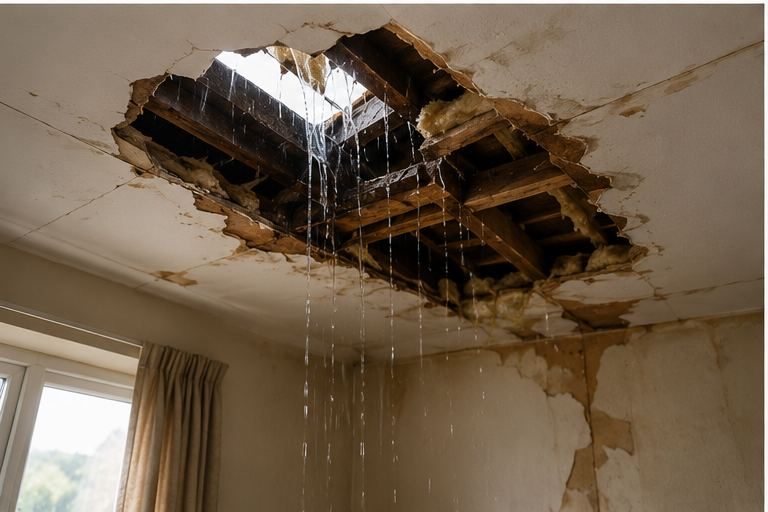
Driving rain finds weaknesses that gravity alone would never exploit: a slightly lifted tile edge, a worn seal around a roof vent or soil pipe, a gap in pointing around a chimney, or ageing flashing that has just enough of a gap to let water push through under pressure. None of these might cause a leak in light, still rain, but under sustained wind-driven downpours they can let in a surprising amount of water.
One of the most important things to understand about this type of leak is that the point where water appears inside the house is not always directly below where it is entering the roof. Water can travel along the underside of roofing felt, run along a rafter, or follow a ceiling joist for some distance before dripping through at the weakest point, which means a ceiling stain in a bedroom might actually trace back to a roof defect several feet away, closer to an eave or valley.
This is why a proper inspection matters more than trying to guess the source from inside the house. Our roofers check the whole roof area around a reported leak, including flashing, tile laps, valleys, and any penetrations such as vents or aerials, rather than assuming the obvious spot is necessarily the cause. In Longwell Green's mix of housing styles, from newer builds to older detached properties, the likely culprit varies depending on roof age and construction.
The orientation of a property can also play a part, since a wall or roof slope facing the prevailing wind direction takes the brunt of driving rain far more often than a sheltered elevation on the same building. Two neighbouring houses can experience quite different levels of exposure depending on how they sit relative to nearby buildings, trees, or open ground, which is one reason a leak pattern that seems unusual is still worth investigating properly rather than dismissed as one-off bad luck. Extensions, dormers, and other additions to the original roofline can also create new junctions that were not part of the house's original design, and these added details sometimes turn out to be the weak point once driving rain finally puts them to the test.
If a leak in your home only seems to appear during wind and rain together, it is worth having it looked at properly rather than living with an intermittent drip, since the underlying cause tends to worsen gradually over time even between visible leaks. Get in touch for a free inspection, and any repair work carried out comes with our 15-year guarantee for peace of mind.
Need Emergency Roof Repairs in Longwell Green?
Every case is different — the fastest way to get an accurate answer is a quick chat with our team.