
A leak doesn't always mean a hole in the roof. Some of the most persistent water ingress problems in Portishead come from wind-driven rain — rainfall pushed at an angle by strong gusts off the estuary, forcing its way into gaps and laps that would comfortably shed water falling straight down. It's a distinction worth understanding, because it explains why a roof can develop a leak during one storm despite having handled years of ordinary rain without issue.
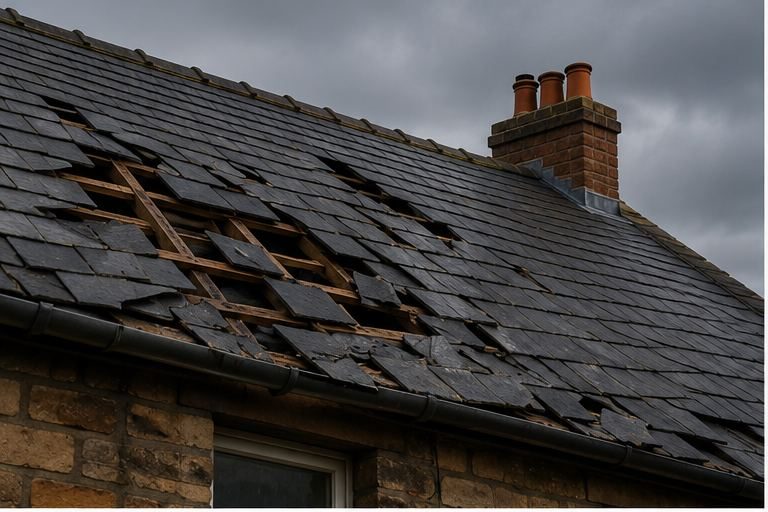
Tile and slate roofs are designed with overlapping courses that rely on gravity to keep water moving downward and outward. When rain is driven sideways or even slightly upward under an eave, that design assumption breaks down, and water can be pushed past laps, under ridge tiles, or into valleys from an angle the roof simply wasn't built to resist. Flat roof sections are similarly vulnerable, with driving rain able to find weaknesses at edges and upstands that would otherwise stay dry. Even well-maintained roofs can let water through under these conditions if a single lap or joint happens to be facing directly into the prevailing wind during a particularly severe spell.
One of the more frustrating aspects for homeowners across Portishead is that a leak's entry point and its visible symptom are often in different places entirely. Water can travel along the underside of roofing felt, run down a rafter, or track across a ceiling joist before dripping through plasterboard well away from where it actually got in. This makes tracing wind-driven rain leaks a job for someone who knows what to look for, rather than a straightforward visual check from the loft hatch.
Left unresolved, this kind of leak tends to recur with every subsequent bout of similar weather, gradually causing more damage to timber, insulation and ceilings each time. Even where a leak seems to have stopped in dry weather, that's not the same as being fixed — it simply means the conditions that caused it haven't returned yet. Many homeowners only take action once a leak has appeared several times, by which point the repeated wetting and drying can have already caused more damage to timber than the original fault alone would have.
A proper inspection focuses on the roof's vulnerable points — laps, valleys, verges, junctions around chimneys and rooflights — rather than just the ceiling where the damp patch has appeared. Once the actual entry point is identified, repair can be targeted rather than guesswork, which tends to be both quicker and more cost-effective in the long run.
If wind-driven rain has caused a leak in your Portishead home, Brunel Roofing Bristol's emergency team can trace the source properly and carry out a lasting repair, backed by a 15-year guarantee on the completed work. We're happy to talk through what we find during an inspection in plain terms, so you understand exactly what caused the leak and why the recommended repair addresses it properly.
Need Emergency Roof Repairs in Portishead?
Every case is different — the fastest way to get an accurate answer is a quick chat with our team.