
Once the wind has died down and it's safe to go outside, most homeowners in Arnos Vale want to know the same thing: where do I even start looking? The honest answer is that you shouldn't start on the roof itself. A visual check from ground level, and inside the loft if you have safe access, will tell you most of what you need to know without putting anyone at risk on a wet, potentially unstable surface, and it's a sensible approach whatever the scale of the storm that has just passed through.
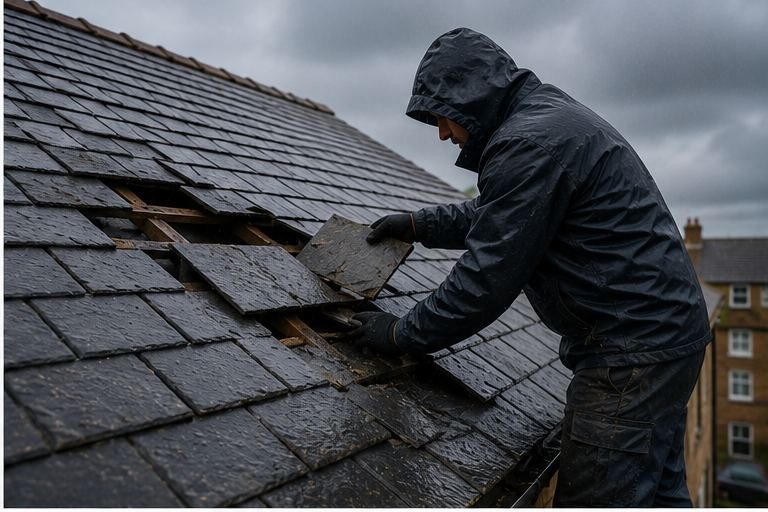
From the ground, walk around the property and look up at the roofline, ideally from more than one angle so you're not relying on a single line of sight. You're checking for anything obviously out of place: tiles or slates that look cracked, slipped, or missing entirely, debris such as broken branches resting against the roof, and any sagging or unevenness along the ridge or valleys. Guttering pulled away from the fascia, and any lead flashing around chimneys that looks lifted or displaced, are also worth noting, since both are common sources of leaks after high winds, even when the tiles themselves look largely intact.
Next, if it's safe to do so, check inside the loft with a torch. Fresh damp patches on the underside of the roof, water staining on timber, or daylight showing through where it shouldn't are all signs that the covering has been breached somewhere above, even if nothing looked obviously wrong from outside. It's worth remembering that a leak indoors is not always directly below where the water is actually entering the roof, so what you find in the loft is a useful clue rather than the whole answer, and it's worth checking a reasonably wide area rather than just the spot directly above any ceiling stain.
Inside living areas, check ceilings and upper walls for damp patches, discolouration, or a musty smell, particularly in rooms directly under the roof. Don't ignore small marks on the assumption they'll dry out on their own; a small stain today can be the first visible sign of a leak that's been developing for longer than it appears, and marks that reappear after drying out are a particularly strong sign that water is still finding a way in somewhere above.
Photograph anything you find before touching or moving it, both for your own records and in case you need evidence for an insurance claim later. Avoid going onto the roof yourself, even for a closer look, since storm-loosened tiles and wet surfaces make this genuinely dangerous work best left to someone with the right training and equipment, and a fall from even a low roof can cause serious injury.
Once you've made these initial checks, an emergency roof inspection carried out by a qualified roofer is the next sensible step for any property across Arnos Vale showing signs of storm damage. Brunel Roofing Bristol provides free inspections and, where needed, a 24-hour emergency call-out to assess the damage properly and recommend the right repair.
Need Emergency Roof Repairs in Arnos Vale?
Every case is different — the fastest way to get an accurate answer is a quick chat with our team.