
Barton Hill sees its fair share of heavy rain over the course of a year, and how well a roof sheds that water depends on more than just the tiles themselves. Moss growth plays a bigger role in a roof's drainage performance than many homeowners realise.
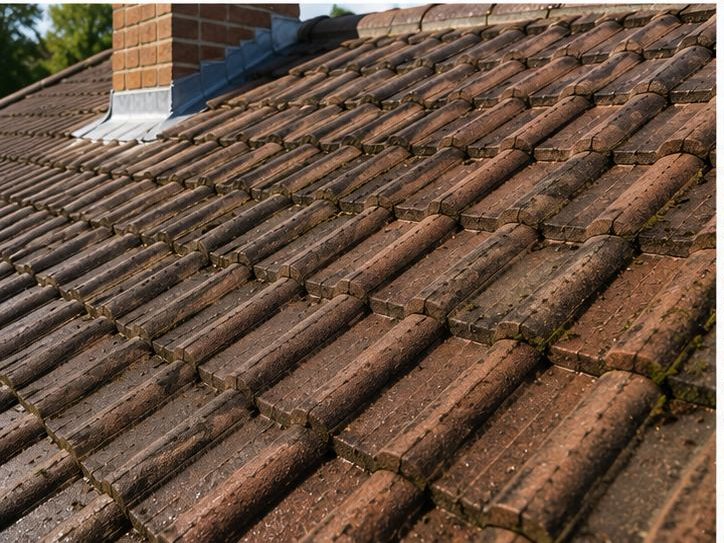
A clean roof surface allows rainwater to run off quickly and efficiently towards the gutters. A roof covered in moss behaves very differently. Moss absorbs and holds a significant amount of water like a sponge, slowing down how quickly rain drains off the tile surface and altering the pattern in which it does so, sometimes directing water into areas of the roof that were not really designed to handle concentrated flow.
Soakaways and drainage further from the property can be affected too, in a less direct but still relevant way. Persistent overflow from blocked gutters sends considerably more water down external walls and into ground-level drainage near the foundations than a properly functioning system would, and over time this can contribute to damp problems at ground level that seem, at first glance, to have nothing to do with the roof at all.
As moss grows and is loosened by wind and rain, fragments regularly break away and wash down with the water, ending up in the gutters below. Over time this material accumulates, and combined with any general debris on the roof, it can significantly reduce a gutter's capacity to carry water away, leading to overflow during periods of heavy rainfall, which Barton Hill, like the rest of Bristol, gets plenty of through autumn and winter.
Blocked or overflowing gutters are not just an inconvenience. Water spilling over the edge of a gutter can run down external walls, contributing to damp issues, and in some cases can find its way behind fascias or soffits, leading to problems that are considerably more involved to put right than the original moss growth ever was.
Valleys and areas around chimneys are particularly worth watching on moss-affected roofs, since these are natural collection points where water flow is already concentrated. Moss build-up in these areas can create localised blockages that redirect water in ways that increase the risk of it finding a way beneath the roof covering rather than off it.
Addressing moss on the roof slopes themselves is therefore closely tied to keeping a property's overall drainage working properly. Removing the growth reduces both the amount of material reaching the gutters and the way water moves across the roof surface, restoring more normal drainage behaviour.
Flat or low-pitched roof sections, sometimes found on extensions or outbuildings in Barton Hill, are particularly worth checking in this context. These already drain more slowly than a steep pitched roof under normal conditions, and moss build-up can make the situation noticeably worse, sometimes leading to standing water pooling on the surface rather than simply slower run-off. Where a property has this kind of roof section alongside its main pitched roof, it is worth having both assessed together rather than focusing on one and overlooking the other.
If you have noticed slow-draining gutters or water pooling in unexpected places on your Barton Hill roof, moss further up the slope could well be part of the cause. Brunel Roofing Bristol can assess the whole picture, from the roof surface to the guttering, and advise on what needs attention.
Get a Free Quote for Roof Cleaning in Barton Hill
Every roof is different — the fastest way to get an accurate answer is a quick chat with our team.