
When a flat roof in Ashley Down needs attention, the choice often comes down to two familiar options: traditional felt roofing, which has been used on British flat roofs for generations, or EPDM rubber membrane, a newer material that has steadily become the more common recommendation among roofing professionals.
Felt roofing has a long track record and remains a reasonably affordable option, particularly for smaller structures like sheds or simple outbuildings. It is typically installed in multiple layers, bonded together, which can work well when done correctly but also introduces more seams and joints into the finished roof, each one a potential point where water could eventually find a way through as the material ages.
Traditional felt also tends to be more affected by temperature extremes than rubber membrane. In hot weather it can soften and become vulnerable to damage, while in cold weather it can turn brittle and prone to cracking, especially around edges and upstands where it is under the most stress. Over time, and especially with strong UV exposure, felt often needs replacing within 10 to 15 years, which is a fairly typical figure across the industry rather than a Brunel-specific guarantee.
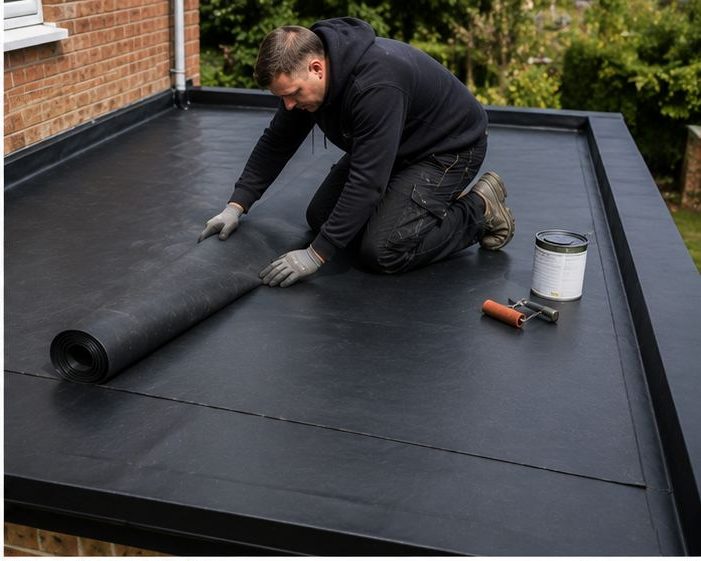
EPDM, by contrast, is a single-ply synthetic rubber membrane, usually installed in one continuous sheet or with far fewer joins than a multi-layer felt system. That single-sheet approach is one of its biggest practical advantages for a property in Ashley Down, since it removes many of the seams that are typically the first thing to fail on an older flat roof.
EPDM also stays flexible across a much wider temperature range than felt, which helps it withstand the seasonal swings of a UK climate without the surface degrading in the same way. It is commonly guaranteed for 20 years or more in the industry when properly installed, reflecting the general confidence roofing professionals have in how the material performs over the long term compared with felt.
That does not mean felt is always the wrong choice. For a small, low-cost structure where budget is the primary concern and a shorter lifespan is acceptable, felt can still be a reasonable option. The right choice really depends on the specific roof, its size, its exposure, how long you want the covering to last, and what your budget allows.
It is also worth remembering that neither material performs well if it is installed over a poor roof deck or badly detailed at the edges and junctions. Good preparation and careful installation make a real difference to how either covering holds up over time, regardless of which one is chosen.
Cost is often the deciding factor that pushes people toward one material or the other in the first instance, and it is true that felt can look cheaper on paper for a like-for-like area. Once the shorter working life of felt is factored in, though, and the likelihood of needing another roof covering sooner, the overall value of EPDM over the years it is expected to last often works out more favourably for many Ashley Down homeowners.
For most Ashley Down homeowners looking for a durable, long-term solution with fewer potential failure points, EPDM tends to be the stronger recommendation. If you would like an honest comparison based on your own roof, Brunel Roofing Bristol can assess the property and advise on the option that best suits your needs and budget.
Get a Free Quote for EPDM Roofing in Ashley Down
Every roof is different — the fastest way to get an accurate answer is a quick chat with our team.