
Before a single new tile goes on, the old roof covering has to come off, and in a place like Redcliffe that first stage needs as much care as anything that follows. Many buildings here sit close to pavements, narrow lanes or neighbouring properties near the Floating Harbour, so falling debris and dust are a real concern rather than a theoretical one. Stripping out is planned as a controlled sequence rather than simply pulling materials off and letting them drop.
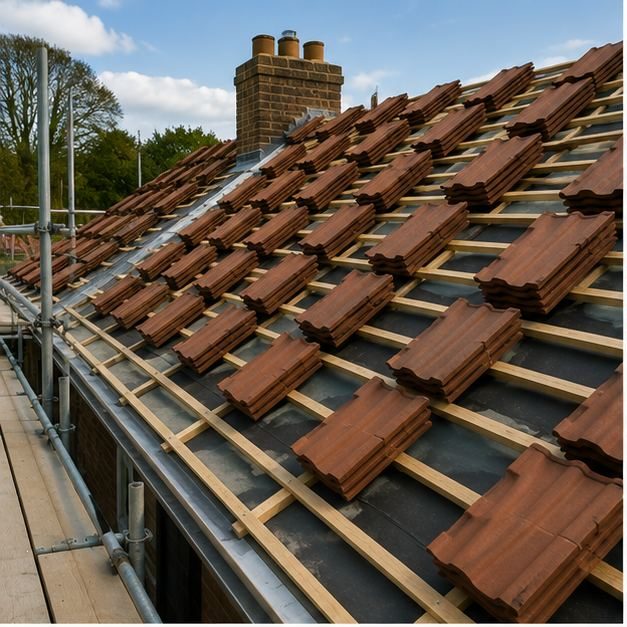
In practice this means working from the ridge downward in manageable sections, so the roof is never left with large open areas exposed to weather for longer than necessary. Old tiles, slates, battens and felt are stacked and lowered rather than thrown, usually via enclosed chutes or by hand into skips positioned to keep the immediate work area contained. On converted warehouse buildings and older terraces around Redcliffe, this careful approach also protects features such as decorative brickwork or original chimney stacks that owners often want kept intact.
Protective sheeting is used to cover parapets, gutters and any lower roofs or extensions that sit beneath the main strip-out area, since debris travelling even a short distance can cause damage or a hazard to people below. Where a property adjoins a shared wall or sits within a dense block of flats, extra attention goes into containing noise and dust for the working day, since Redcliffe's mix of residential and commercial neighbours means disruption needs to be kept to a minimum.
Once the covering is off, the roof timbers and any existing felt are briefly assessed before work continues, partly so nothing structurally significant is missed and partly to confirm the strip has gone as planned. Skips and waste are cleared promptly rather than left to accumulate on site, which matters on streets with limited space for parking or deliveries.
Timing plays a part too. Strip-out is generally scheduled for settled weather where possible, and the amount of roof opened up on any given day is judged against the forecast rather than pushed to cover as much ground as quickly as possible. On a taller building overlooking the harbour, wind speed is also factored into the day's plan, since gusts can make loose material and sheeting far harder to control safely at height. Where a property has restricted access, such as a converted building reached only via a narrow lane, waste removal is planned around suitable delivery and collection windows so skips and vehicles do not obstruct the street for longer than necessary.
Personal protective equipment, edge protection and secure scaffold access are all part of keeping the strip-out safe for the roofing team as well as for anyone passing below, and none of this is treated as optional simply because a job looks straightforward from the ground.
A safe, well-organised strip-out sets the tone for everything that follows on a re-roof, and it is one of the details that separates a properly managed job from a rushed one. If you would like to know more about how Brunel Roofing Bristol plans this stage for a property in Redcliffe, get in touch for a quote and we can talk you through it.
Get a Free Quote for New Roof Installations in Redcliffe
Every roof is different — the fastest way to get an accurate answer is a quick chat with our team.