
Clifton's period buildings present a particular challenge for flat roofing that newer properties simply don't have: how do you join a modern membrane neatly and watertight to stonework, aged brickwork, parapet walls and chimney stacks that were never designed with a rubber roof in mind? Getting this detailing right is arguably the single most important part of a successful EPDM installation on an older building.
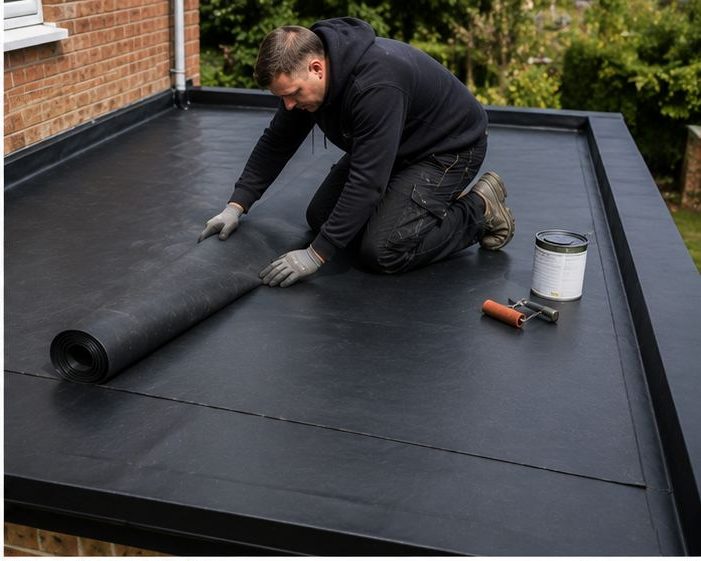
The junction between a flat roof and an adjoining wall is one of the most common places for leaks to develop, precisely because it's where two very different materials meet. On a Clifton property, this might be a rear extension roof meeting the original Victorian brick wall of the main house, or a garage roof running up against a boundary wall. EPDM is typically dressed up the wall face and secured under a counter-flashing or termination bar, creating a mechanical seal that's designed to cope with the natural movement between roof and wall over time.
Chimney stacks present a similar but slightly more involved challenge, particularly on the older properties common across Clifton where chimneys are often a solid, characterful feature rather than a minor detail. The membrane needs to be dressed carefully around the base of the stack, usually with the help of purpose-made corner pieces, and properly weathered at the top to stop water tracking back down behind the flashing.
Parapet walls, which appear on many Clifton townhouses and villas, require their own approach again. The membrane typically needs to run up and over the parapet, or be dressed into a groove cut into the masonry, so that water is directed away from the joint rather than being able to sit against it. On older stonework, this sometimes needs a slightly more bespoke solution than a standard detail catalogue would suggest.
It's worth saying that these junctions aren't a weakness of EPDM as a material - they're simply the inherent challenge of joining any flat roof to a period building, and they exist regardless of which covering is chosen. What makes the difference is whether the installer has genuine experience working on older Clifton properties and takes the time to get each junction right, rather than applying a generic approach designed for a modern new-build.
A properly detailed EPDM roof on a period property should perform reliably for many years, with the junctions being the part of the job that most separates a good installation from a poor one.
Getting these junctions right often takes longer than fitting the flat field of the roof itself, and it's an area where experience genuinely shows. An installer who has worked regularly on Clifton's period housing will recognise the particular quirks of older stonework and brickwork far more readily than one used only to modern new-build detailing.
Taking photographs and keeping a record of how junctions were detailed can also be genuinely useful for future reference, particularly on a property that may see further building work down the line.
If you have a flat roof on a period Clifton property with tricky junctions against stonework, chimneys or parapets, it's worth having it assessed by a contractor experienced with older buildings. Brunel Roofing Bristol would be glad to take a look and advise on the right detailing for your property.
Get a Free Quote for EPDM Roofing in Clifton
Every roof is different — the fastest way to get an accurate answer is a quick chat with our team.