When it comes time to re-cover a flat roof in Filton, EPDM rubber and GRP, more commonly known as fibreglass, are two of the most frequently considered modern options, and homeowners often find themselves weighing up the differences between them. Both are considerable improvements over older felt roofing in terms of durability, but they differ from each other in some important practical ways that are worth understanding before making a decision.
GRP is applied as a liquid resin reinforced with glass fibre matting, which cures on site to form a hard, rigid, seamless surface. This rigidity gives GRP a genuinely walkable, robust finish that some Filton homeowners value, particularly for roofs that will be used regularly for access, such as reaching a higher window or maintaining equipment on the roof. However, that same rigidity means GRP has essentially no flexibility to accommodate movement in the deck beneath it, and if the timber structure flexes, even slightly, due to thermal changes or minor settlement, the resin can crack.
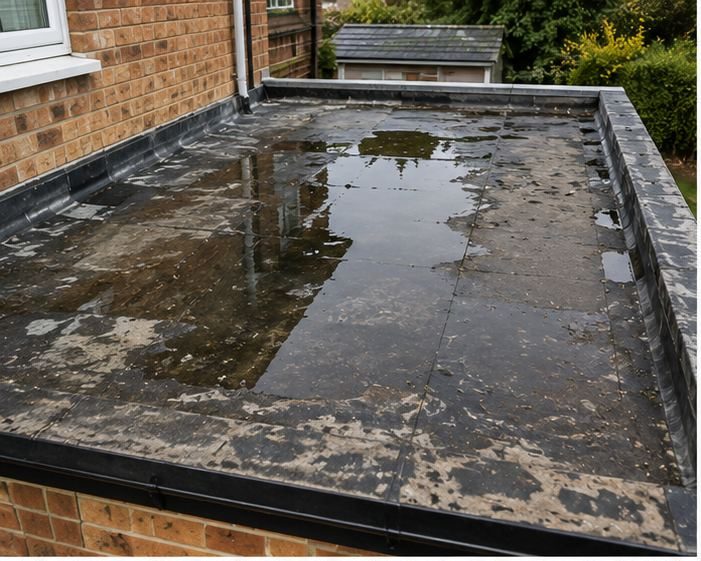
EPDM, by contrast, is a flexible synthetic rubber membrane installed as large sheets rather than a liquid-applied system. That flexibility allows it to move with the roof deck without cracking, which many roofing professionals consider a significant practical advantage, particularly on roofs over extensions where some structural movement over the years is a realistic possibility. EPDM also typically has fewer seams than a GRP installation with multiple sections, since GRP roofs larger than a single roll of matting require joints between sections that need careful lamination.
Repairability is another point of difference worth considering. If EPDM is damaged, a patch repair using compatible rubber materials is generally a relatively quick and effective fix. Repairing GRP typically involves grinding back the damaged resin and re-laminating a new section, which is a more involved process requiring specific conditions and expertise to achieve a good match and bond with the existing surface.
Cost is broadly comparable between the two systems for a typical domestic roof, though this varies depending on roof size, complexity and the specific specification chosen, so it is not usually the deciding factor on its own. Appearance is a matter of personal preference: GRP offers a smooth, glossy, uniform surface, while EPDM has a slightly matte, rubber-like finish, and both are available in a small range of colours.
For most Filton homeowners, the decision often comes down to how the roof will be used and how much value is placed on flexibility versus a hard, walkable surface. A roof that will see regular foot traffic might lean towards GRP, while a roof over an extension where minor structural movement is expected, or where minimal seams and easy repairability are priorities, often points towards EPDM.
Longevity guarantees are also worth comparing directly when weighing up the two systems for a specific Filton property, since the length and terms of the guarantee offered can vary between installers and specifications regardless of which material is chosen, and this is a reasonable question to ask any contractor providing a quotation for either system.
If you are trying to decide between EPDM and GRP for a flat roof in Filton, it helps to discuss your specific roof, how it will be used, and what matters most to you with a professional who can install either system properly. Brunel Roofing Bristol can talk through both options honestly and recommend whichever suits your property and circumstances best.
Get a Free Quote for EPDM Roofing in Filton
Every roof is different — the fastest way to get an accurate answer is a quick chat with our team.