
If you live in Eastville, you've probably noticed at least a trace of moss on your roof at some point - a light green tinge on the north-facing slope, perhaps, or a few tufts creeping along the ridge line. A small amount of moss is extremely common in this part of Bristol and isn't automatically a sign of a problem. The question most homeowners really want answered is when that moss has tipped over from cosmetic to concerning.
The clearest visual sign is thickness. A thin layer of moss that looks like green dust or staining is very different from cushion-like clumps that sit proud of the tile surface. If you can see moss standing several millimetres above the roofline, or forming continuous mats along whole courses of tiles rather than isolated patches, that's usually a sign growth has been left unchecked for some time.
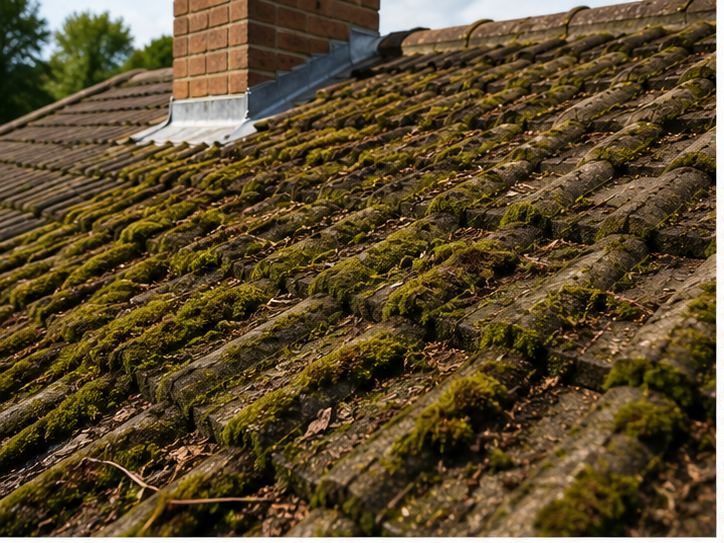
Location matters too. Eastville has a good mix of Victorian terraces and later semis, many with roof slopes shaded by neighbouring buildings, chimneys or nearby trees along the streets. Moss almost always establishes first on north or east-facing slopes that stay damp longest after rain, so a heavier build-up on one side of the roof than the other is completely normal and not, on its own, cause for alarm.
What is worth paying attention to is what the moss is doing to the roof underneath it. Moss holds moisture against the tile surface for far longer than an exposed, well-drained roof would experience naturally, and on older tiles this can gradually accelerate wear. If you notice tiles that look slightly displaced, ridge mortar that's crumbling or pitting near moss clumps, or granules and tile fragments collecting in the gutter, that's a stronger indicator that it's time to get the roof looked at properly.
Another practical sign is what happens after heavy rain. Loose moss washing down onto a patio, driveway or car parked below the eaves is a fairly reliable clue that growth has reached the point where chunks are breaking away and travelling down the roof, which usually means it's also building up in the gutters.
It's also worth having a look at how much of each slope is affected rather than fixating on a single patch. A few isolated clumps around a chimney stack are a very different situation to moss covering a large proportion of a roof face - the latter is more likely to be trapping damp against the structure over a wide area rather than just a localised spot.
Because every roof in Eastville sits at a slightly different pitch, age and exposure, it's difficult to give a one-size-fits-all rule for what counts as too much moss from photos or a quick look from the pavement. That's really where a proper roof assessment earns its keep - checking not just how much moss is present, but what condition the tiles and mortar underneath are actually in.
It's also sensible to view roof moss in the context of your Eastville neighbours' properties, particularly where houses share a very similar roof design, as with many of the area's terraces. If your roof is significantly greener or more heavily covered than similar properties nearby facing the same direction, that relative comparison can be a useful early clue that something about your particular roof, perhaps a section of damaged flashing retaining extra moisture, is encouraging growth faster than it should.
If you're unsure whether what you're seeing on your Eastville roof warrants action, Brunel Roofing Bristol are happy to take a look and give you an honest opinion, along with a straightforward quote if cleaning is genuinely worthwhile.
Get a Free Quote for Roof Cleaning in Eastville
Every roof is different — the fastest way to get an accurate answer is a quick chat with our team.