
Walk along many of the streets in Hillfields and you will see rows of Victorian and Edwardian terraces, most with pitched slate or clay tile roofs that have been up there for well over a century. Moss and algae growth on these roofs tends to creep up gradually, which is exactly why so many homeowners only notice it once it has become fairly established and visible from ground level, sometimes only when a neighbour or a passer-by happens to mention it.
The most obvious sign is colour. Healthy slate or tile should look fairly uniform in tone, so patches of green, grey-green or almost black growth are usually the first clue something is building up. This is especially common on north-facing slopes and on roofs that sit in the shadow of a neighbouring terrace or a mature tree, both of which are common features across Hillfields due to the tightly packed housing and the number of established gardens in the area. Even a relatively small patch of discolouration is worth noting, since it tends to mark the spot where conditions are most favourable for further growth to spread from.
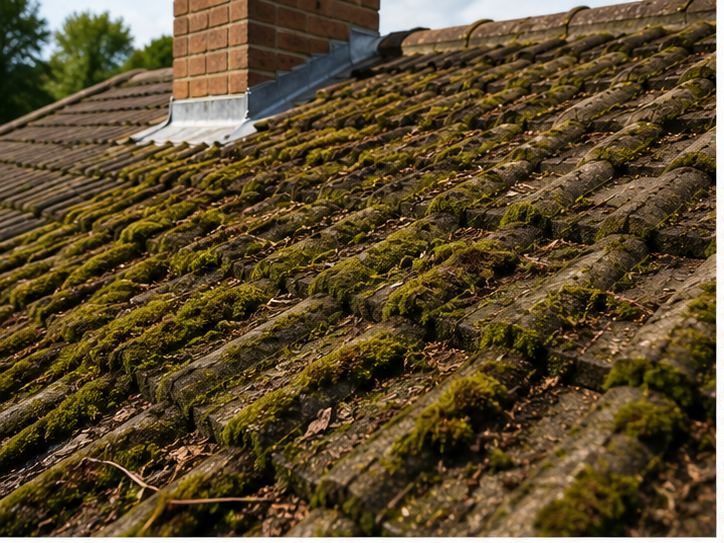
Texture matters too. Light surface algae can look almost like a stain, but moss itself tends to form raised, cushion-like clumps that hold their shape even in dry weather. If you can see obvious lumps rather than flat discolouration, that is generally a sign the growth has had time to root itself into the surface of the tile or between the laps, which is worth having looked at before it spreads further. Running a hand lightly along a low, easily reached section, where it is safe to do so, can also reveal a spongy or matted texture that is not always obvious from a distance.
Guttering is another good indicator. Moss sheds fragments as it grows and as rain washes over the roof, and these fragments collect in gutters and downpipes. If you are finding small clumps of green debris in your gutters, or noticing water overflowing during heavy rain where it did not before, moss further up the roof is often the underlying cause, even if the roof itself does not look especially bad from street level.
Streaking on brickwork or render below the roofline, particularly under valleys or where two roof slopes meet, can also point to moss holding excess moisture against the roof and channelling dirty run-off down the wall. On a lot of the older Hillfields properties this shows up quite clearly against lighter render or painted brick, appearing as dark vertical streaks that tend to worsen after each spell of wet weather.
It is also worth checking both the street-facing and rear-facing slopes, since aspect and shading can differ significantly between the two even on the same house. A front elevation that gets more sun through the day may stay relatively clear while a shaded rear slope, backing onto gardens or other properties, develops moss much faster, so a quick look from an upstairs window at the back of the property is often just as useful as checking from the pavement.
Not every trace of growth needs immediate action. A light dusting of lichen on an otherwise sound roof can often simply be monitored, and does not automatically call for treatment. But once moss has formed thick, established clumps, or you are seeing repeated gutter blockages and staining, it is a sensible point to get a professional assessment rather than waiting for the situation to get harder, and more costly, to manage.
If you have spotted any of these signs on your Hillfields roof and would like an honest opinion on whether cleaning is needed and what it would involve, Brunel Roofing Bristol is happy to take a look and talk through the options with you.
Get a Free Quote for Roof Cleaning in Hillfields
Every roof is different — the fastest way to get an accurate answer is a quick chat with our team.