
The eaves are the lowest edge of a pitched roof, where the tiles or slates overhang the wall and meet the gutter, and they take a disproportionate amount of punishment over a roof's lifetime. Rain concentrates here as it runs off the whole slope, and it is often the first place where deterioration becomes visible. When we carry out a new roof installation in Kingsweston, rebuilding the eaves properly is one of the more detailed parts of the job, even though it covers a relatively small area of the overall roof.
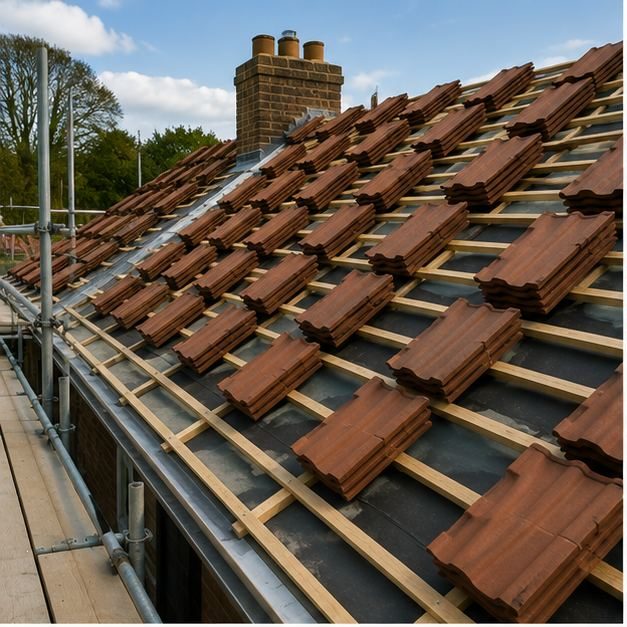
Work usually begins with stripping back the old tiles or slates at the eaves course and exposing the rafter feet, fascia and any existing eaves felt or tray. This is a useful opportunity to check the condition of the timber underneath, since rafter ends near the eaves are prone to damp exposure and can suffer from rot that is not obvious from the ground. In a mix of older and newer properties like those found around Kingsweston, the condition of this timber varies considerably, and it needs to be assessed rather than assumed. Where a rafter foot has softened or split, it is far better to sister in new timber or replace the affected section now, while everything is exposed, than to cover it over and hope it holds.
Once the substrate is confirmed sound, a new eaves support tray or felt upstand is fitted to guide the underlay correctly into the gutter, followed by a tilting fillet that lifts the first course of tiles to match the pitch of the rest of the roof. Getting this detail right matters more than it might seem, because an eaves course that sits at the wrong angle will look uneven from the street and can direct water incorrectly at the lowest, most vulnerable point of the roof. The tilting fillet also has a practical purpose beyond appearance: without it, the first course of tiles would sit flatter than the rest of the roof, leaving a small gap under the tail of each tile where wind could drive rain back up and underneath.
The fascia and any soffit boarding are then reinstated or replaced as needed before the first course of tiles or slates is laid, tying the new roof covering neatly into the guttering below. Any ventilation strip or bird proofing that forms part of the specification is fitted at this stage too, since it is far easier to install cleanly before the tiles go down than to retrofit afterwards. On a full re-roof, rebuilding the eaves alongside the rest of the roof means every layer, from timber to tray to tile, is renewed as one coherent system rather than patched piecemeal, which is a genuine advantage over trying to repair an eaves detail in isolation on an otherwise ageing roof.
Once the first course is laid and checked for line and level, the guttering is refitted or adjusted to sit correctly against the new fascia, completing the eaves as a single working unit from rafter to downpipe. This final check matters because even a well-built eaves detail can be let down by guttering that was never realigned to match it.
If you have noticed sagging, staining or moss build-up along the lower edge of your roof, it is worth having the eaves looked at properly rather than treating it as a minor cosmetic issue. Brunel Roofing Bristol can inspect the eaves detail on your property in Kingsweston and set out clearly what a full rebuild would involve, along with a written quote for the work.
Get a Free Quote for New Roof Installations in Kingsweston
Every roof is different — the fastest way to get an accurate answer is a quick chat with our team.