
Old Market sits right on the edge of Bristol's historic core, close to Cabot Circus and the M32, but not every building here matches the busy, built-up image most people have of the area. Along some of the quieter side streets you'll still find smaller, more modest terraced houses with a plainer, almost village-scale character, sitting alongside taller Georgian townhouses, older commercial buildings and newer flat conversions. For homeowners in these smaller properties, a new roof needs a different approach to the one used on a grander terrace or a converted warehouse nearby, because the building's proportions, construction and history all pull in a different direction.
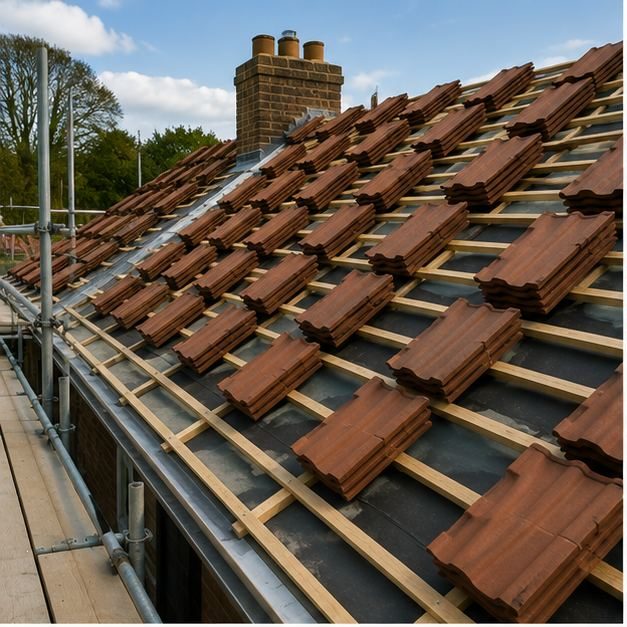
These more compact houses generally have simpler, steeper roof pitches than their taller neighbours, and were often covered in smaller tiles that give them their unassuming, homely appearance. When it comes to replacement, keeping that original scale in mind matters a great deal. A covering that looks perfectly at home on a large townhouse can look oversized and clumsy on a smaller property, throwing off the proportions of the whole building and the row it sits within, particularly where two or three of these smaller houses stand together and were clearly meant to read as a matching set.
Because these smaller Old Market homes tend to have less complicated roof structures, a full re-roof is often quicker to plan and price than on a larger or more architecturally elaborate building, though age can still bring surprises once the old covering comes off. Softened battens, tired sarking boards and timber that has quietly deteriorated over the decades are all fairly common finds, particularly around old nail holes and areas where felt has perished, and dealing with them properly at the point of replacement is what makes a new roof last rather than simply look tidy for a season or two before problems resurface.
A well-specified new roof on one of these smaller houses can also make a genuine difference to comfort day to day, cutting down on the draughts and creeping damp that build up gradually in an older, poorly ventilated roof space, especially where the loft has never been properly insulated or vented. Replacing the covering, membrane and ventilation together, rather than tackling each element separately over time, gives a far more reliable result and avoids paying for scaffolding access more than once for what is ultimately the same job.
It's also worth remembering that even the smallest, plainest roof in Old Market still needs to be tied in correctly to its neighbours, its guttering and any adjoining structures, so the finished job should never be treated as a lesser or simpler version of a larger project, just a differently scaled one.
If you own one of Old Market's smaller, more traditional houses and want a re-roof that respects its scale and character while bringing it up to a modern standard, Brunel Roofing Bristol can carry out an inspection and talk you through the options that genuinely suit the property.
Get a Free Quote for New Roof Installations in Old Market
Every roof is different — the fastest way to get an accurate answer is a quick chat with our team.