
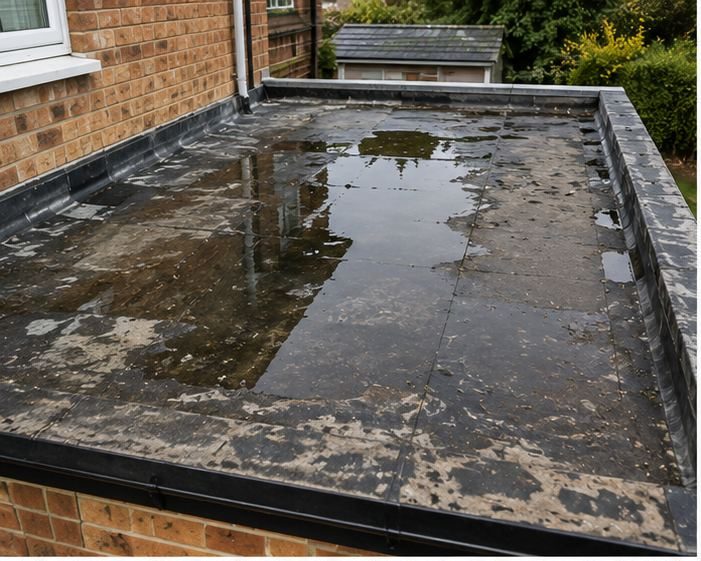
Standing water on a flat roof is one of the most common issues we are called out to investigate across Kingsweston, and it is a problem worth taking seriously, because water that does not drain away properly can significantly shorten the life of any roof covering, including EPDM. Understanding what typically causes drainage problems helps explain why they need addressing rather than simply left as a minor cosmetic issue.
The most frequent cause is inadequate fall, or pitch, across the roof surface. A flat roof is never actually completely flat; it should be constructed with a slight gradient directing water towards outlets, gutters or a drainage point. Where that fall is insufficient, was never properly built in, or has been lost over time due to deck movement, water has nowhere to go and simply sits on the surface after rain. We see this on a number of older extensions and garage roofs in Kingsweston, particularly where the original construction predates current guidance on falls.
Blocked or poorly positioned outlets are another common culprit. Even a well-designed roof with correct falls can suffer drainage problems if the gutter, downpipe or outlet itself becomes blocked with leaves, moss or general debris. Flat roofs tucked beneath overhanging trees or close to boundary walls are especially prone to this, and regular clearing of outlets is one of the simplest ways to prevent water building up unnecessarily.
Sagging or deflection in the roof deck can also create low spots where water collects, even on a roof that was originally built with adequate fall. This tends to happen gradually as timber ages or where past water damage has softened sections of the boarding, and it is one of the reasons deck condition is checked so carefully whenever a roof covering is being replaced.
Poorly detailed edges and upstands contribute to drainage issues as well. Where a membrane does not extend far enough up a wall or upstand, or where trims have not been fitted correctly, water can be forced against a junction rather than channelled away, increasing the risk of it finding a way in over time rather than simply causing surface ponding.
It is worth being clear that a small amount of temporary water sitting after heavy rain is not unusual on any flat roof and does not necessarily indicate a fault. The concern is water that remains for an extended period, days rather than hours, since prolonged ponding puts sustained pressure on seams, trims and the membrane surface itself.
Addressing drainage problems properly usually means looking beyond the roof covering to the structure and detailing beneath it, rather than treating the symptom alone. When we install EPDM systems in Kingsweston, falls, outlet positions and edge detailing are all considered as part of the specification, precisely because getting drainage right at installation avoids far more disruptive problems later on.
If you have noticed water sitting on a flat roof at your property, or damp appearing that might be linked to drainage rather than a straightforward leak, Brunel Roofing Bristol can inspect the roof and explain what is causing it, along with a clear recommendation on the best way to resolve it properly.
Get a Free Quote for EPDM Roofing in Kingsweston
Every roof is different — the fastest way to get an accurate answer is a quick chat with our team.