
Larger flat roofs in Sneyd Park tend to develop leaks for a slightly different set of reasons than a small, simple garage roof, mostly because there's more roof, more detailing, and more history to contend with. Understanding the common causes helps make sense of why a leak has appeared and what's actually needed to fix it properly.
One of the most frequent causes is failure at a joint or seam, particularly on older roofs still covered in felt, where multiple overlapping layers each represent a potential weak point. On a large roof with many square metres of joints, it only takes one to fail for water to start finding its way in, often some distance from where the resulting damp patch eventually appears inside.
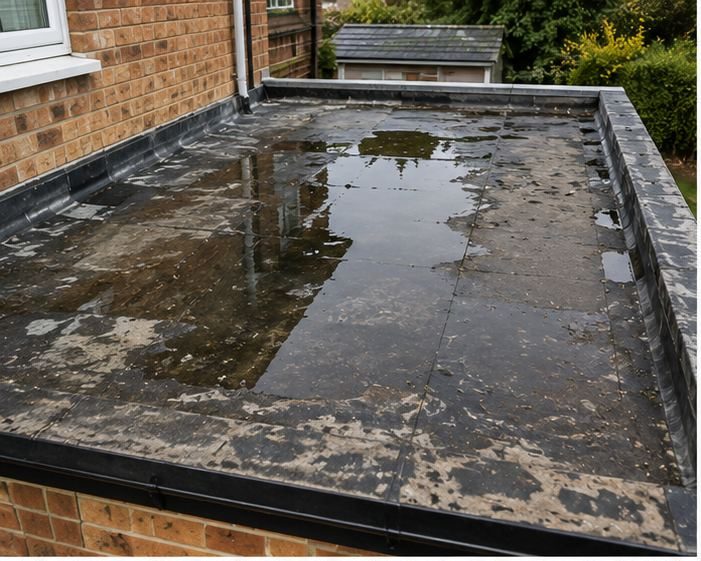
Historic patch repairs are another surprisingly common cause on larger, older Sneyd Park roofs. Where a previous repair was carried out quickly or with mismatched materials, it can create a new weak point of its own, and over time these accumulated patches — each done at a different point in the roof's history — can end up being collectively responsible for more leaks than the original covering ever was.
Poor detailing around penetrations is another common culprit on bigger, more complex roofs. Sneyd Park properties often have several roof lights, chimney stacks, pipes and other features passing through the roof surface, and any one of these that was poorly sealed during a previous installation or repair can become a persistent source of leaks over time.
Standing water is a contributing factor too, particularly on larger roofs where falls weren't originally designed generously enough, or where the roof has settled slightly over the years. Water that sits for extended periods puts more strain on the membrane and any joints or detailing in that area than water that drains away quickly, gradually increasing the risk of failure.
Blocked or inadequate drainage compounds this problem on larger roofs, especially those with mature trees nearby, which is common in Sneyd Park's leafier streets. If outlets become partially blocked with leaves and debris, water can back up across a wider area of roof than it would otherwise, increasing the pressure on the membrane and any vulnerable details.
Age and general wear are unavoidable factors too. Felt roofing in particular tends to become brittle and prone to cracking as it ages, especially on sections exposed to significant sun, and once the material starts to fail in one area it's often an indication that other sections of an ageing roof aren't far behind.
It's also worth being aware that water doesn't always leak straight down from where it enters a roof — on a larger structure it can travel sideways along the deck or between layers before finding a way through the ceiling below, sometimes appearing a considerable distance from the actual point of failure. This is one of the main reasons DIY leak-chasing on a big Sneyd Park roof so often fails to find the real problem.
Because larger roofs can develop leaks from several different causes at once, tracing the actual source often takes some careful investigation rather than a quick surface look. Brunel Roofing Bristol can properly inspect a larger Sneyd Park roof, identify what's actually causing a leak, and recommend whether targeted repair or a fuller EPDM re-cover is the right solution, along with a clear quotation.
Get a Free Quote for EPDM Roofing in Sneyd Park
Every roof is different — the fastest way to get an accurate answer is a quick chat with our team.