
One of the most common places for a flat roof to leak is not out in the open field of the roof itself, but right at the edge where it meets a house wall. This is a pattern Brunel Roofing Bristol sees repeatedly on extension and garage roofs across Horfield, and understanding why it happens helps explain why this junction needs particular care during installation.
At a wall junction, the flat roof membrane has to turn upwards and be dressed against, or ideally tucked into, the brickwork above roof level. This upward turn, combined with the change in material and the movement that naturally occurs between a roof and a wall over time, makes it one of the more technically demanding parts of any flat roof to get right, and correspondingly one of the more common places for a poor original installation to fail.
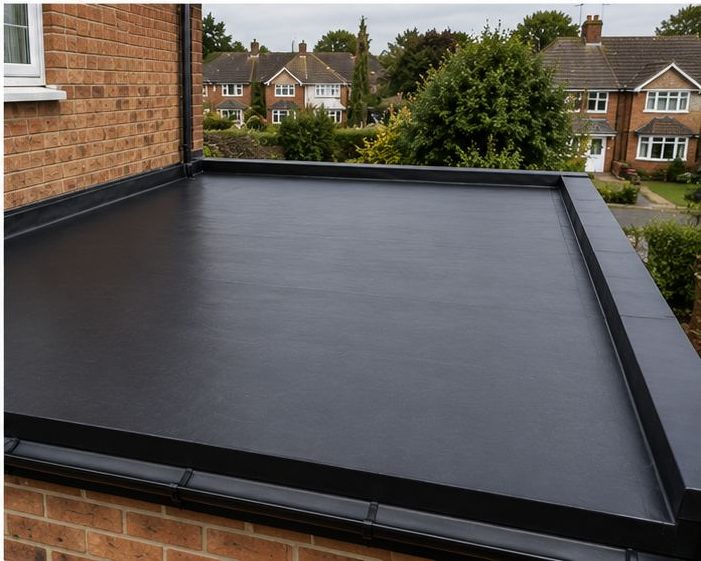
A frequent cause of leaks at this junction is a membrane that has simply been dressed up against the wall face and sealed with mastic, rather than properly chased into the brickwork or tucked behind a flashing. Sealant alone tends to degrade with UV exposure and weathering over a period of years, and once it starts to crack or shrink, water finds its way behind the upstand and into the wall or roof structure below.
Differential movement between the roof and the wall is another factor. A flat roof extension and the original house it is attached to can move slightly differently from one another due to their different foundations, structures and rates of thermal expansion. Over time, this movement can open up small gaps at a junction that was not detailed with enough flexibility to accommodate it, something that is especially relevant on older Horfield properties where an extension has been added well after the original build.
Poor upstand height is a further common issue. Building regulations and good practice both call for a minimum upstand height at any wall junction so that water does not simply run up and over the edge of the membrane during heavy rain or when wind-driven water hits the wall. A junction detailed with too low an upstand is vulnerable regardless of how well the membrane itself has been installed elsewhere on the roof.
Chimney breasts and parapet returns raise similar issues on some Horfield properties, since they introduce additional corners and changes in direction that all need to be dressed correctly. Every corner is effectively another opportunity for a leak if the membrane is not formed and bonded properly around it.
The good news is that these junction failures are entirely preventable with correct detailing at installation, and where an existing roof is already leaking at a wall junction, it can usually be properly repaired rather than requiring a full roof replacement, provided the rest of the membrane is in reasonable condition.
If you have noticed damp or staining near where a flat roof meets a wall on your Horfield property, it is worth having that junction inspected specifically. Brunel Roofing Bristol can identify exactly what has gone wrong and recommend the right fix, whether that is a targeted repair or a fuller re-roof.
Get a Free Quote for EPDM Roofing in Horfield
Every roof is different — the fastest way to get an accurate answer is a quick chat with our team.