
Lead is one of the oldest roofing materials still in everyday use, and for good reason: properly worked, it forms a durable, flexible weatherproof barrier around exactly the kind of junctions that cause problems on complex roofs. Chimneys, valleys, abutments and dormer cheeks all rely on lead flashing to keep water out, and on the more detailed roofs found across Longwell Green, there tends to be considerably more lead involved than on a simple, unbroken roof surface.
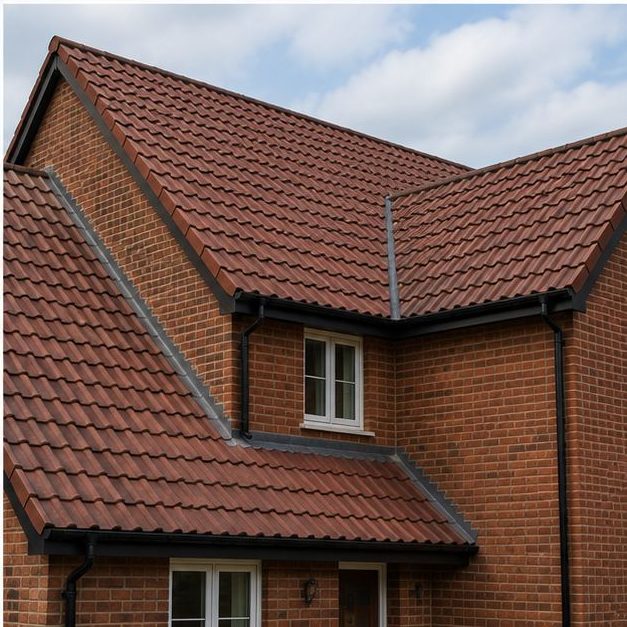
The skill in leadwork lies in the dressing, which is the process of shaping lead sheet by hand to follow the exact profile of a junction. A stepped flashing running down alongside a chimney needs each step dressed neatly into the brickwork joints, while a valley gutter needs to be formed with the correct falls so water runs cleanly away rather than pooling. Done well, this work is barely noticeable once complete. Done poorly, it tends to show up fairly quickly as staining, slipped sections or leaks at exactly the points where different roof surfaces meet.
On a complex Longwell Green roof with several chimneys, valleys or dormers, the sheer amount of leadwork required means there is more room for inconsistency if the work is rushed or handled by someone without proper experience in the trade. A roofer who is confident tiling a plain slope is not automatically confident dressing lead around an awkward three-way junction, and it is worth knowing that the same team, or at least the same standard of skill, is being applied to both parts of the job.
Cost is sometimes raised as a reason to substitute lead with cheaper alternatives, and there are legitimate modern products that can perform well in the right situation. But on the more architecturally detailed roofs around Longwell Green, where junctions are frequent and exposure to wind-driven rain can be significant, properly dressed lead remains a reliable choice precisely because it can be shaped to fit awkward details in a way that rigid alternatives sometimes cannot.
Lead thickness, or code, also needs to be matched correctly to its application, since a code that is adequate for a small soaker is not necessarily heavy enough for a wide valley gutter or a chimney back gutter that has to cope with a large volume of water in heavy rain. Using an undersized code to save on material cost is a false economy on a detailed roof, since it tends to lead to splitting or creasing over time as the lead expands and contracts with changes in temperature, eventually opening up the very joints it was meant to protect.
If your roof includes a good deal of detailed junction work, it is worth asking directly about the leadwork experience of whoever you are considering for the job. Brunel Roofing Bristol carries out leadwork to a high standard as part of every re-roof, and can talk through exactly where lead will be used on your Longwell Green property and why.
Get a Free Quote for New Roof Installations in Longwell Green
Every roof is different — the fastest way to get an accurate answer is a quick chat with our team.