
Where a chimney stack meets a sloping roof, there's a junction that has to cope with more movement, more water and more weathering than almost any other part of a house. That junction is sealed with lead flashing, and understanding how it works helps explain why it's such a common source of leaks on properties in Ashley Down.
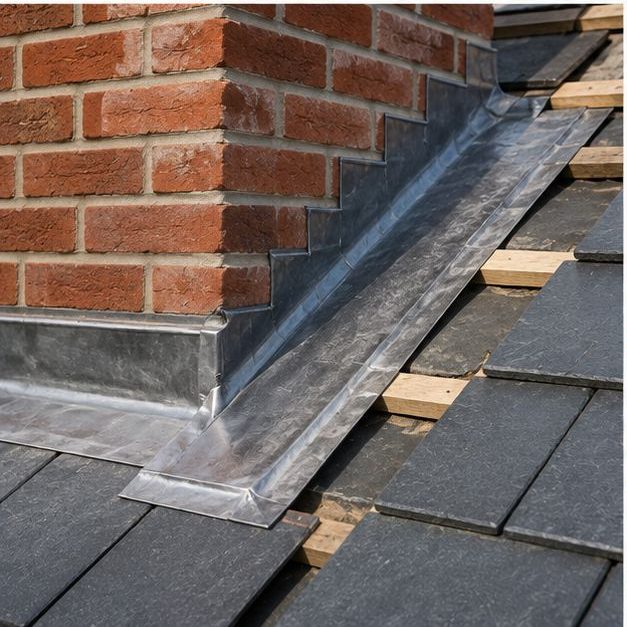
Flashing is formed from sheet lead, dressed into a raked-out mortar joint on the brickwork side and lapped over the roof covering on the other, so that water running down the stack is directed onto the roof rather than finding a gap to exploit. Because lead is soft and workable, it can be shaped tightly around the chimney's profile, but that same softness means it moves with temperature changes over the years, gradually loosening at the joints it was originally sealed into.
Failure tends to show up in a few predictable ways: the lead lifting away from the brickwork where the mortar has weathered out from around it, splits appearing at folds and corners where the metal has been worked hardest, or the flashing simply having perished after decades of UV exposure and thermal cycling. On the taller Victorian and Edwardian stacks common in Ashley Down, this weathering is often more advanced than on lower, more sheltered parts of the roof.
Alongside the main flashing, soakers are fitted under the tiles or slates directly against the chimney to handle water at each individual course, and a back gutter deals with water running down the upslope side of a wider stack. All three work together, and a weakness in any one of them can let water through even if the others are sound, which is why a proper repair usually means assessing the whole assembly rather than just patching the most obvious gap.
Lead remains the industry standard for chimney flashing because of how well it can be worked into shape and how long it lasts compared with lighter-weight alternatives, and a lead repair carried out correctly should easily outlast several redecorations of the roof around it. Cutting corners with a lighter or unsuitable material to save on cost tends to be a false economy once early failure is factored in. If a roof is due for re-covering, or scaffolding is already going up for another reason, it's often worth renewing flashing that's showing early wear at the same time, rather than paying for separate access later once it's failed outright. Lead that's holding but clearly ageing is a good candidate for planned replacement rather than waiting for a leak to force the issue.
A quick sealant fix over failing lead might buy a season, but it rarely lasts, and cracked mastic often makes the eventual proper repair harder to carry out cleanly. If you're seeing damp near a chimney breast, or simply want ageing flashing checked before it fails, we offer free inspections across Ashley Down and repair or replace leadwork properly, with a 15-year guarantee on the finished work.
Get a Free Quote for Chimney Repairs in Ashley Down
Every chimney is different — the fastest way to get an accurate answer is a quick chat with our team.