
Flashing failures are one of the more common causes of chimney-related leaks found on properties across Patchway, and also one of the trickier problems to spot early, because the lead itself sits tucked against the brickwork where it is not easily seen from ground level or even from most loft spaces without a close inspection carried out from above. Many homeowners only discover a flashing problem exists once water has already started to show itself somewhere inside the property.
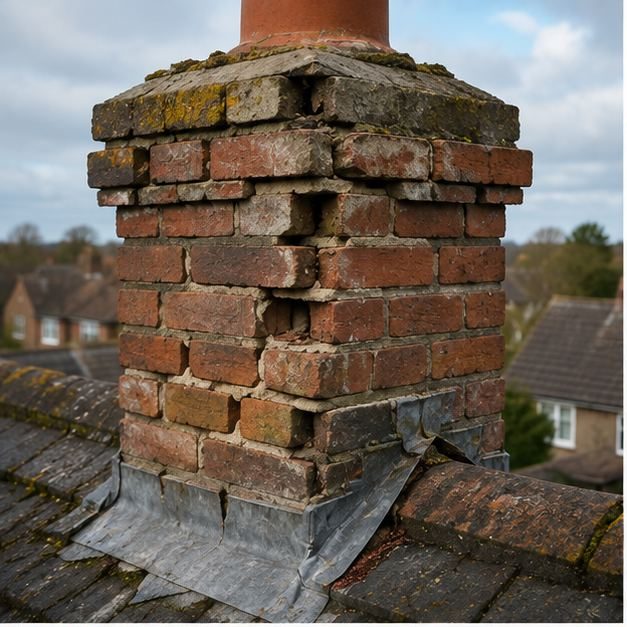
The flashing around a chimney typically consists of stepped lead dressed into the mortar joints of the brick, soakers fitted beneath each course of roof tiles to direct water away from the stack, and in many cases a back gutter positioned above the chimney to channel water around it. Any one of these elements failing, whether through age, storm damage, or mortar in the flashing groove crumbling away and letting the lead lift, can allow water into the roof structure even while the tiles themselves remain in perfectly good condition on the surface. This is why a leak is sometimes wrongly blamed on the tiles or slates when the actual cause lies in the leadwork tucked beneath and around them.
On some of Patchway's older properties, flashing may be original and simply reaching the natural end of its service life after decades of exposure to the elements. On newer builds, flashing failures are more often the result of poor original installation, storm damage dislodging a section, or, in some cases, cheaper flashing alternatives having been used in place of proper lead during a previous repair, which tend not to last as long as the real thing. Genuine lead remains the standard for good reason, since it can be dressed tightly into brick joints and roof profiles in a way cheaper alternatives generally cannot replicate.
Diagnosing a flashing leak properly means understanding that water does not always show up directly below where it enters. It can travel along a rafter, or down the inside of a chimney breast, before appearing as a damp patch some distance from the actual point of failure, which is why a proper inspection traces the water back to its source rather than assuming the nearest visible damage marks the entry point exactly. This can mean checking the loft space during or shortly after rainfall, since some leaks are only obvious while water is actively tracking through the structure.
Repairs typically involve removing the damaged flashing and dressing new lead into a properly re-cut mortar joint, work that generally requires scaffold access on anything beyond a single-storey extension roof, both for safety and to allow the lead to be dressed accurately rather than rushed into place under time pressure. Rushed lead work is one of the more common reasons a flashing repair fails again within just a year or two of being carried out.
If you have noticed a damp patch near a chimney breast in your Patchway home, Brunel Roofing Bristol can inspect the flashing, trace the actual source of any leak, and provide a free, no-obligation quote for the repair needed, with emergency call-out available if the issue is urgent.
Get a Free Quote for Chimney Repairs in Patchway
Every chimney is different — the fastest way to get an accurate answer is a quick chat with our team.