
It is easy to assume that a chimney leak means a problem with the brickwork, but in a great many cases the actual culprit is the leadwork, the flashing and soakers that seal the junction between the stack and the roof covering. For homeowners in Hotwells, understanding this distinction can save time and money by pointing any inspection in the right direction from the start, rather than at the brickwork alone. Getting the diagnosis right first also avoids the frustration, and expense, of repointing brickwork that was never actually the source of the problem in the first place.
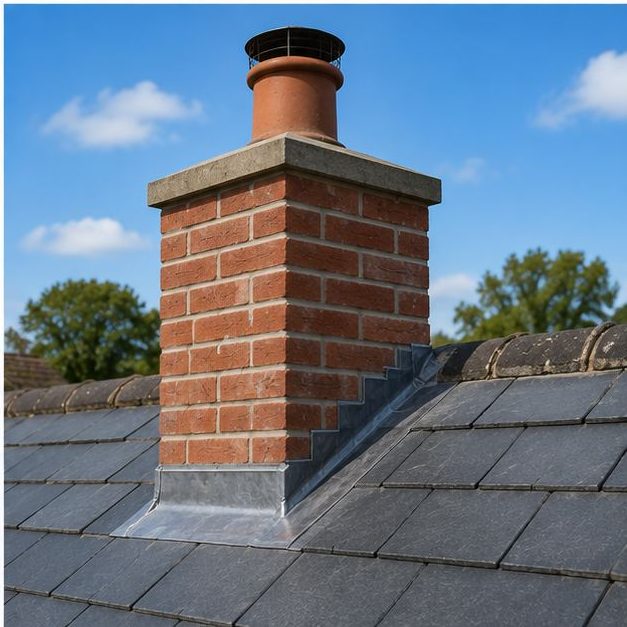
Flashing is the skirt of lead dressed around the base of the stack, tucked into a mortar joint so that water sheds away from the junction rather than tracking behind it. Soakers work alongside it, small individual pieces of lead interleaved with the tiles or slates on each side of the stack, directing water down and around rather than letting it find a way underneath the roof covering itself.
On taller terraced properties around Hotwells, where roofs are often steep and stacks sit high above the street, this leadwork can be original or decades old, and it fails in fairly predictable ways over time: lifting away from the brickwork as the mortar joint it sits in erodes, splitting from age and repeated thermal movement, or corroding thin after years of exposure to weather coming in off the water, which can be more punishing here than on more sheltered inland streets. Salt in the air near the water can also accelerate corrosion in lead that has been in place for many decades, something less of a factor on properties further inland.
A particularly tricky feature of leadwork failures is that the resulting leak can appear well away from the actual point of entry. Water finding its way past a lifted piece of flashing can travel along a rafter or run beneath the roofing felt for some distance before it finally finds a gap and drips through the ceiling below, meaning the visible damp patch inside is not necessarily a reliable guide to where the fault actually is.
Proper repair means stripping back the old lead, preparing a clean mortar joint, and dressing in new code lead correctly, secured mechanically rather than relying on mastic or sealant, which tends to perish within a season or two. It is a job worth doing properly the first time, since redoing failed sealant repairs repeatedly is a false economy that costs more in the long run. Code lead is specified by thickness for a reason, and using too thin a gauge to save money tends to shorten the life of the repair considerably.
If your Hotwells property has a leak near a chimney, it is worth having the leadwork properly inspected rather than assuming the worst about the brickwork. Brunel Roofing Bristol offer free inspections and can carry out lasting leadwork repairs backed by a 15-year guarantee.
Get a Free Quote for Chimney Repairs in Hotwells
Every chimney is different — the fastest way to get an accurate answer is a quick chat with our team.