
A damp patch appearing on a ceiling or around a chimney breast is one of the more unsettling things a homeowner in Hotwells can notice, not least because the obvious assumption, that the leak is coming from directly above the stain, is often wrong. Water has a habit of travelling before it finally shows itself indoors, which makes tracing chimney leaks properly something of a skill in itself, best left to someone who does it regularly.
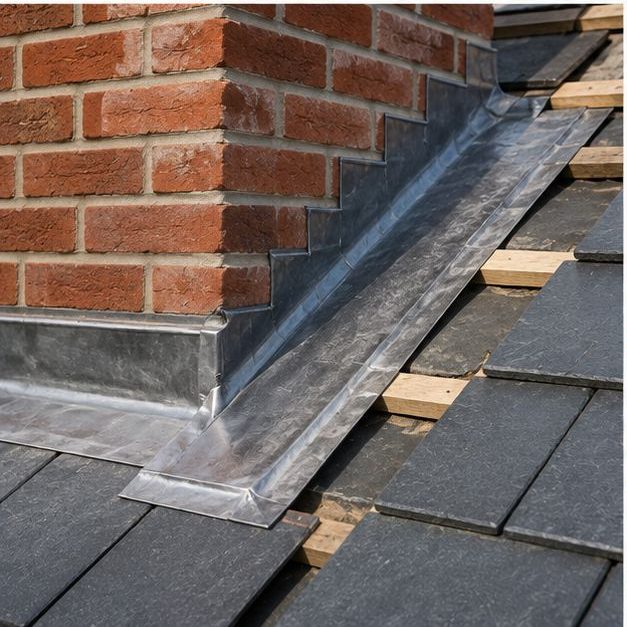
There are several possible sources for water finding its way into a chimney breast: failed flashing or soakers where the stack meets the roof, cracked flaunching at the top of the stack letting water straight down the flue, deteriorated mortar joints allowing water into the brickwork itself, or, less commonly, a cracked pot. Each of these produces water ingress that can look identical by the time it reaches a ceiling, even though the fix required is quite different in each case. Even the direction a stack faces can be a useful clue, since the side that takes the worst of the prevailing weather is statistically more likely to be where a fault has developed.
The reason the visible damp patch can be misleading is that water rarely travels in a straight vertical line once it gets past the roof covering. It can run along a rafter, follow the line of roofing felt, or track down the inside face of a flue for some distance before finding a gap and dripping through. On tall terraced properties common in Hotwells, with steep pitches and stacks positioned well above the loft space, this travel distance can be considerable, meaning the source might be a metre or more from where the stain actually appears on the ceiling.
Properly tracing a leak usually means a close inspection of the stack itself, checking flashing, soakers, flaunching and mortar joints in turn, sometimes alongside a look inside the loft at the relevant section of roof timber and felt to see where staining or moisture is actually concentrated. Guesswork from inside the house alone rarely identifies the true cause with any confidence, and can lead to money spent on the wrong repair entirely. Timing can help too, noting whether a leak appears during light rain, heavy rain, or specifically during wind-driven storms, since each pattern points towards a slightly different likely cause.
Once the actual source is identified, the repair itself is often more straightforward than the diagnosis, whether that turns out to be re-dressing a section of lead, repointing a stretch of mortar, or renewing cracked flaunching. Getting the diagnosis right the first time avoids paying for a repair that turns out not to have addressed the real problem, only for the leak to reappear at the next heavy rain.
If you have a chimney leak on your Hotwells property that has proven hard to pin down, a proper roof-level inspection is the way to get a definitive answer. Brunel Roofing Bristol offer free inspections, and a 24-hour emergency call-out service if the leak is causing active damage.
Get a Free Quote for Chimney Repairs in Hotwells
Every chimney is different — the fastest way to get an accurate answer is a quick chat with our team.