
Leadwork rarely gets much credit when it is doing its job properly, quietly keeping water out of the junction between a chimney and the surrounding roof for years without anyone giving it a second thought. It only becomes noticeable when it fails, and on older buildings in Old Market that failure can be years in the making before a leak actually shows up indoors, often first appearing as a faint discolouration rather than an obvious wet patch. By the time the problem is visible from inside the property, water has often been finding its way in for considerably longer than most homeowners would expect.
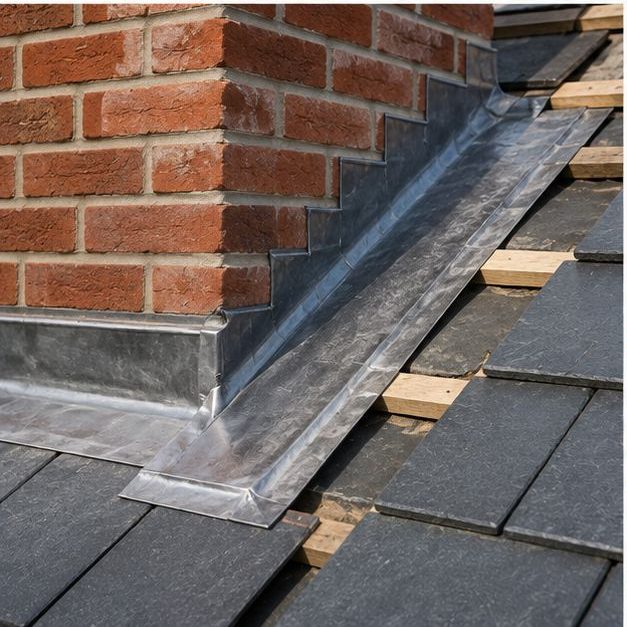
The lead around a chimney is usually made up of stepped flashing dressed into the mortar joints of the brickwork, soakers woven in beneath each course of roof tiles to channel water away from the stack, and often a back gutter above the chimney to divert water around it rather than letting it collect against the brick. Any one of these components failing, whether through age, cracking, or the mortar groove holding the flashing crumbling away, can let water in even while the roof covering itself looks entirely sound from a distance. This is part of why leadwork problems are so often missed during a purely visual check carried out from ground level.
On older properties, original leadwork can last a remarkably long time, but many decades-old installations are now reaching the point where the lead itself has become brittle and prone to cracking, particularly where it has been repeatedly patched with cheaper materials rather than replaced properly in the past by previous contractors working to a tighter budget. Recognising the difference between leadwork that simply needs a minor repair and leadwork that has genuinely reached the end of its life is part of what a proper inspection is for.
One of the more frustrating aspects of a leadwork leak is that the damp patch that eventually appears indoors is not necessarily directly beneath the point where water is getting in. Water can run along roof timbers or down the inside face of a chimney breast for some distance before showing itself, which means a proper repair starts with tracing the leak back to its actual source rather than patching the area nearest the visible stain and hoping for the best. Getting this step right the first time avoids paying for repeat visits to chase the same leak under a different guise a season later.
Repairing failed leadwork means removing and replacing the damaged sections with new lead dressed correctly into a re-cut mortar groove, work that on the taller terraces typical of Old Market generally needs scaffold access to be done safely and accurately rather than rushed from a ladder in a hurry.
If you have spotted a damp patch near a chimney breast, or simply want your leadwork checked before the wetter months arrive, Brunel Roofing Bristol can inspect the stack and trace any leak to its source, with a free quote for whatever repair is actually needed.
Get a Free Quote for Chimney Repairs in Old Market
Every chimney is different — the fastest way to get an accurate answer is a quick chat with our team.